From patient records to workforce efficiency and resource allocation, healthcare organizations are responsible for managing countless moving parts, all while delivering high-quality patient care. As information management becomes increasingly complex, healthcare organizations are looking for technology solutions that can help reduce the burden. VDC Strategy’s 2025 Buyer Behavior Guide surveyed senior enterprise mobility decision makers to better understand the challenges they face, the initiatives they prioritize, and the technologies they believe will have the greatest impact. In the healthcare sector, nearly half of respondents identified EHR adoption, digitalization, and interoperability as a leading challenge in 2025. As a primary tool for accessing information, EHRs are foundational to healthcare operations, and understanding the factors that limit their effectiveness can provide valuable insight into areas for innovation.
Exhibit 1: Primary Challenges Faced in Ensuring Effective EHR Use
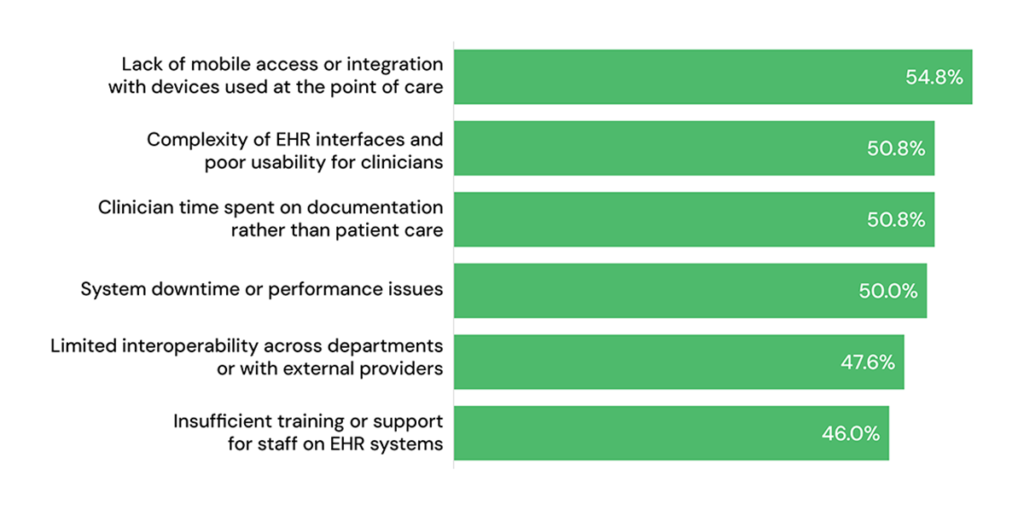
The most cited barriers to effective EHR use are tied to a lack of workflow efficiency and system usability. Improvements in mobile access, navigation, and documentation processes could help healthcare organizations reduce friction in daily operations. To address these EHR challenges, healthcare organizations are prioritizing technologies that help clinicians spend less time navigating systems and more time helping patients. Specifically, VDC’s report found that healthcare leaders ranked AI-assisted clinical documentation automation as the most important technology for improving EHR effectiveness, followed closely by mobile-enabled access to EHR data. Leveraging AI to streamline EHR processes could help reduce the time clinicians spend on administrative tasks, allowing them to focus more on patient care.
Efforts to address documentation challenges are already gaining momentum across the healthcare technology market. For example, Nvidia recently partnered with Abridge to develop a healthcare-focused ambient listening AI model designed to transcribe doctor-patient conversations (The Wall Street Journal). Initiatives like this reflect increasing confidence in AI-assisted documentation as a tool for improving EHR effectiveness.
While healthcare organizations see significant potential in AI-driven solutions, concerns surrounding the adoption of automated EHR documentation tools continue to influence implementation decisions. Accuracy and reliability of AI-generated documentation, integration with existing EHR platforms, and patient data privacy and HIPAA compliance emerged as the top concerns. These concerns are echoed in recent research, published in peer-reviewed journals such as Frontiers and BMC Health Services Research, which suggests that hallucination risk management remains an important consideration as AI documentation technologies evolve. Healthcare organization leaders are eager to use AI to improve efficiency, but they also want to ensure documentation remains accurate, secure, and easy to implement.
As healthcare organizations continue to seek more efficient information management, technologies that improve EHR effectiveness, including AI-assisted automation, have become an important area for innovation. However, EHR optimization represents only one of many challenges shaping the healthcare industry. Organizations are also evaluating solutions that improve operational efficiency, strengthen data security, enhance patient experiences, and address evolving industry challenges.
For a deeper look into the healthcare technology landscape, explore VDC Strategy’s Latest Report: “Rising Patient Experience Demands in Healthcare”.