The 2026 outbreak wave shows why digital traceability is now a strategic capability, not a compliance checkbox
The United States is currently experiencing its largest cyclosporiasis season on record, with a nine-state outbreak linked to iceberg lettuce from a single farm in central Mexico, processed by Taylor Farms de Mexico and served through Taco Bell. Weeks later, Taylor Farms pulled jalapeños and prepared retail products containing them from Target, Walmart, Whole Foods, and other retailers due to salmonella contamination, prompting Chipotle and Qdoba to remove jalapeños from their restaurants as the outbreak spread to 27 states.
Food safety is an operational challenge addressed through data capture and identification. The cost and reach of a recall depend on whether product identity, lot, and event data were captured accurately, and whether those records can isolate affected product before uncertainty forces a broader withdrawal.
Taylor Farms’ traceability systems capture grower, ranch, lot, harvest date and time, with chain-of-custody documentation extending from field through shipment, and that maturity showed. FDA traceback identified the company as the lettuce supplier on July 17th, and Taylor Farms announced removal of all central Mexico-sourced iceberg lettuce from the US market that same day. But the breadth of the recall also reveals the limits of a sophisticated system: Taylor Farms removed all lettuce sourced from the implicated farm rather than a narrowly defined harvest lot, because the underlying contamination event could not be isolated with sufficient specificity. Digital records enabled rapid identification and removal, but couldn’t prevent a broad recall when the event itself wasn’t pinned down precisely enough.
Recall precision comes in four flavors, in descending order of specificity: by lot, batch, and date code; by source and harvest window; by production line and time window; and, worst of all, by after-the-fact expansion, when a boundary drawn with incomplete information has to be widened once more implicated product surfaces. The 2025 ready-to-eat pasta recall followed exactly that shape: three products became eighteen. Every day of uncertainty translates directly into unnecessarily destroyed inventory and financial loss.
Faster and More Precise Recalls Lead the Realized-or-Expected Benefits
What benefits has your organization realized or expects to realize from serialization/traceability initiatives?
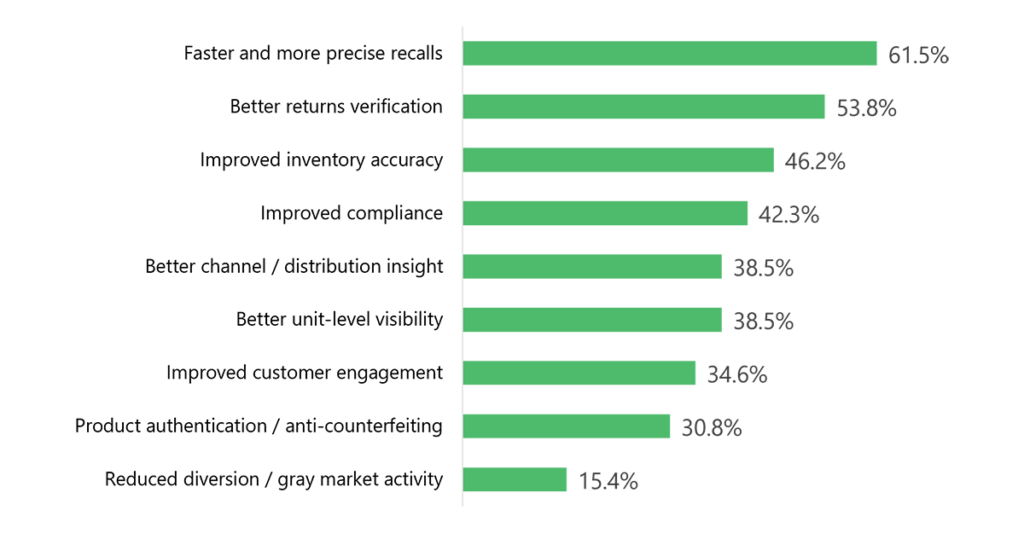
VDC’s recently concluded Serialization & Traceability survey of Food & Beverage organizations confirms that operational return, not just compliance, is what’s actually driving investment. Faster and more precise recalls ranked first among realized or expected benefits at 61.5%, ahead of better returns verification (53.8%) and improved inventory accuracy (46.2%). Improved compliance ranked fourth, at 42.3%, confirming that regulatory requirements like FSMA 204 matter, but are far from the only rationale. The opportunity for solution providers is broader than compliance: recall execution, inventory control, returns management, and day-to-day supply chain visibility.
The direct recall expense is typically far less costly than the reputational exposure. PepsiCo recorded $136 million in pre-tax Quaker Oats recall charges in 2023 and another $187 million in 2024. Following the October 2024 E. coli outbreak linked to McDonald’s Quarter Pounders, US restaurant traffic swung from positive growth to declines of 6.7% the week the outbreak became public and 7.7% the week after, and McDonald’s committed $100 million to rebuild affected franchisees’ traffic and consumer confidence.
The FDA’s 30-month extension to FSMA 204 enforcement won’t stop the ecosystem from moving. Walmart and Kroger have already set their own, earlier supplier deadlines, and for suppliers selling into those accounts, the commercial deadline has already passed. Brand owners need an automated, recurring capability for updating labels and preserving lot and batch identity, instead of a series of one-off compliance projects. Standardizing GS1 identifiers and event-data standards across ecosystem participants can drive recall precision and real operational efficiency, reduce avoidable food waste, and protect brand reputation, whose financial impact can far exceed the direct cost of the recalled inventory. That’s what turns food safety from a regulatory burden into a strategic capability for building consumer trust.
Want the full picture? Download VDC’s latest report, Containing the Recall: Reinforcing Food Safety with Digital Traceability Initiatives here.