VDC recently published a report focused on Dimensioning Solutions. The following blog highlights some of our thoughts on this market and its potential.
The market for dimensioning solutions (also known as cubing solutions) is expanding. For years, these solutions were used for dimensioning products and parcels for efficient storage, package sizing, and quality checks and have recently come to gain greater attention beyond the transportation and logistics industry. According to the new report from VDC Research on enterprise requirements for dimensioning solutions, 55% of respondents across the manufacturing, retail, wholesale/distribution and logistics industries indicate currently using dimensioning solutions to support applications from inventory management, to order management and shipping in hubs across supply chains including distribution centers, manufacturing shop floors, warehouses, retail back of stores, and offices.
Exhibit: Top leading drivers for interest and (potential) investments in dimensioning systems
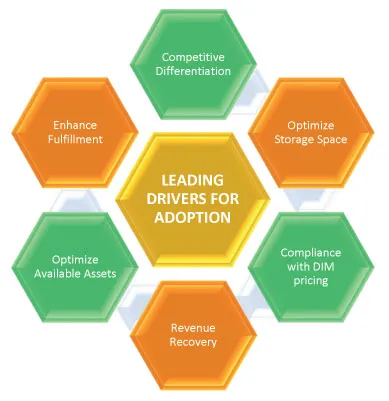
While e-commerce, shipping and dim-based pricing serve as a relatively substantial driver for adoption, research indicates that it and common outbound processes including truck/trailer load optimization, delivery planning and shipping manifestation may not be the major reasons companies are implementing dimensioning solutions. 67% of installed solutions today are used primarily to support inbound workflows to maximize operational efficiency and optimize storage capabilities in the warehouse by dimensioning inbound items. The e-commerce sales boom has placed significant operational pressures on organizations to improve inventory management, spatial optimization, order fulfillment, and pallet building. These also align with the dimensional weight-based pricing models laid out by leading 3PLs like FedEx and UPS.
One of the more interesting findings is the need for dimensioning irregular shaped items. 57% of items today being shipped by organizations are cubical in shape including but not limited to corrugate boxes, mail/letters, pallets/large freight, and parcels versus 43% that are irregular shaped items. Such irregular shaped items could be polybags, burlap/cloth, backpack/bags, luggage and even items that cannot be fit into a container and hence shipped without packaging.
The benefits of dimensioning solutions can be applied through four major form factors: static, in-motion, pallet, and handheld (mobile solutions). These form factors deploy a variety of non-contact sensing technologies including but not limited to laser, infrared light, cameras, and ultrasound in order to accommodate packages in a variety of shapes, sizes, colors, and materials. Currently, leading dimensioning solution vendors in the market include those by CubicScan, Datalogic, Mettler Toledo, Postea, and SICK. Each vendor offers its own unique set of form factors using various underlying dimensioning technologies.
Going forward, competitive differentiation, storage/asset optimization, compliance with dimension-based (DIM) pricing and improving service will the major adoption drivers for dimensioning solutions. Solution providers believe dimensioning will become an integral part of the organizations’ operations as automation solutions and dimensioning can work very effectively together to increase storage density, accurately capture valuable data, and improve overall operational efficiencies.
For more information and insights about the Dimensioning Solutions Market, please feel free to download the Executive Brief to our report or contact us to learn how to gain access to the full report at info@vdcresearch.com.