Sunset the Brand? Do the Math First
Recently we’ve been involved with a company that has completed over a dozen add-on acquisitions and retained all the brands it inherited. The logic behind the decision made sense, but was arrived at through a lot of heavy and inefficient debate that occurred without a structure. After taking a step back, we realized three things.
- First, we felt the decision could benefit from much more rigorous analysis and expanded thinking regarding the costs and benefits of brand retention versus sunsetting.
- Second, we identified that there are some considerations related to brand sunsetting in industrial and operational tech that are unique, critical and easy to overlook.
- And third, we felt investors and operators were without a playbook for making this important strategic decision, creating an opportunity for us to develop one.
After an add-on acquisition, consolidating the acquired company under the platform’s brand can appear to be an obvious source of value. A unified brand may reduce marketing costs, simplify the portfolio, improve cross-selling, and create a clearer identity at exit.
In industrial and operational technology markets, however, the acquired brand may be embedded in engineering specifications, approved vendor lists, channel partnerships, installed equipment, certifications, and contracts. As a result, terminating the brand can have real financial implications.
The decision to sunset a brand should be subjected to similar financial rigor as the decision to consolidate facilities or ERP systems, looking at a broad range of costs and benefits.
That does not necessarily mean the brand should be preserved. With sufficient investment, most of these connections can be transferred to the platform brand through a diligence rebranding effort. Customers can be re-educated, channel partners retrained, specifications updated, and certifications and contracts changed.
The question is whether doing so is economically worthwhile.
Most companies bring considerably more financial rigor to an ERP consolidation or facility rationalization than to a brand decision. Brand architecture is often determined through a mixture of management preference, customer research, design considerations, and a general desire for simplicity. The visible rebranding budget may be estimated, but the wider commercial costs and benefits are rarely evaluated with the same discipline applied to other value-creation initiatives.
Our advice is that in working with their portfolio companies, private equity investors should approach the decision more systematically, but without pretending it can be reduced to a perfectly precise financial model.
A simple equation for the decision
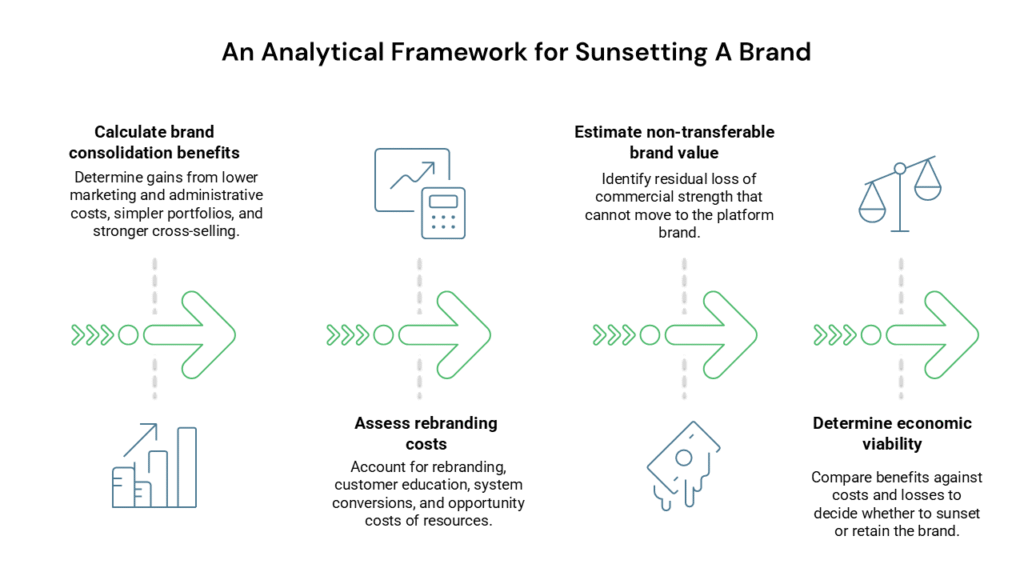
The economics of sunsetting an acquired brand can be determined using a straightforward equation:
Net value of sunsetting
=
Benefits of consolidation
–
Full cost of rebranding
–
Value that cannot be transferred
Let’s take a look at each element.
Benefits of consolidation may include lower ongoing marketing and administrative costs, a simpler portfolio, stronger cross-selling, greater awareness of the platform’s full capabilities, and a more coherent story at exit. Some benefits, such as eliminating duplicate websites, agencies, trade shows, and collateral, can be estimated with reasonable confidence. Others, including cross-selling improvements or a higher exit valuation, require assumptions.
The full cost of rebranding extends well beyond a traditional rebranding budget. It includes customer and channel education, specification and approved-vendor-list changes, recertification, contract updates, product relabeling, systems conversion, management attention, and potential sales disruption. It also includes opportunity costs. Commercial and technical resources devoted to the transition cannot simultaneously be used to win new customers, launch products, or enter new markets.
Value that cannot be transferred to a new brand reflects the possibility that some of the legacy brand’s commercial strength may not move to the platform brand regardless of the investment made. Customers may not attribute the acquired company’s reputation for reliability or technical expertise to the platform. Channel partners may become less willing to advocate for it. Reopening specifications may allow competitors into previously secure positions. This residual loss is the least precise element of the equation, but ignoring it effectively assumes that all brand equity is perfectly transferable.
If the benefits of consolidation exceed the rebranding costs plus any likely residual losses by a comfortable margin, sunsetting the brand makes economic sense. If they do not, retaining or endorsing the legacy brand may create more value.
More discipline without require false precision
First, we want to stress that the equation is a decision framework, not a formula for which every input can be calculated exactly.
Some elements should be quantified directly. Duplicated marketing costs, website expenses, signage, packaging changes, certification fees, legal work, channel training, systems conversion, and internal labor can all be estimated. These costs should be modeled over the expected transition period.
Other elements are likely better estimated through scenarios. The company might model low, base, and high cases for customer attrition, sales disruption, specification loss, channel productivity, and cross-selling improvement. The objective is not to claim that a brand sunset will reduce revenue by exactly 2.3%. It is to determine whether the decision remains attractive if revenue at risk is 1%, 3%, or 5%.
Some considerations may remain primarily qualitative. If the acquired brand is regarded as the technical authority in a specialized market while the platform brand has little credibility there, assigning a precise value to that difference may be artificial. But the absence of a precise number does not make the issue economically irrelevant. It should be explicitly documented, tested through customer and channel research, and reflected in the range of possible outcomes.
The standard should be decision-useful estimation, not artificial certainty.
Determine what must be transferred
To estimate the costs and risks credibly, investors need to understand what the acquired brand actually owns. In industrial and OT markets, that equity usually appears in five places, some of which are unique to industrial and operational tech and easy to overlook.
Customer equity is the awareness, trust, and preference the brand has earned among engineers, operators, maintenance teams, procurement leaders, and other decision-makers. The key question is whether it affects consideration, win rates, retention, or pricing.
Specification equity exists when the brand or its products are included in engineering designs, approved product lists, bids, RFPs, OEM platforms, or corporate purchasing standards. These positions can often be transferred, but doing so may require substantial administrative, sales and engineering effort. Reopening a specification can also invite competitive review.
Channel equity reflects the extent to which distributors, integrators, representatives, and service partners actively recommend and support the brand. Retraining a channel is straightforward when partners primarily fulfill existing demand. It is more difficult when they have built their own market position around the acquired name.
Installed-base equity comes from deployed equipment and the future replacement, service, software, parts, consumables, and expansion revenue it can generate. Customers may continue searching by the legacy brand and part numbers for many years, requiring the company to maintain clear connections between the old and new identities.
Regulatory and contractual equity includes certifications, registrations, warranties, contracts, government approvals, and vendor qualifications tied to the brand, product, manufacturer, or legal entity. Transferring them to a new brand may require notice, consent, requalification, or recertification.
These five forms of equity are not five reasons to preserve every acquired brand. They identify where rebranding expenses, commercial disruption, and residual value loss are most likely to reside, and all bear consideration.
Hardware is solved, data is not. The process data and field records inside current industrial portfolio companies become more valuable as physical AI matures.
Evaluate the benefits with equal discipline
In our experience, companies often scrutinize the risks of brand consolidation without defining what consolidation is expected to accomplish. Here, it is important to be specific. Will one brand materially improve cross-selling, or is the barrier actually separate sales teams and limited account coordination? Will it reduce marketing costs, and by how much? Will customers better understand the combined portfolio? Will the platform brand improve the acquired business’s credibility, recruiting, or market access? Will a unified identity strengthen the exit narrative in a way that matters to likely buyers?
Without concrete answers, brand consolidation can become an aesthetic preference but not a value creation strategy.
The benefits should also be assessed over the sponsor’s hold period. A transition that costs heavily in years one and two but produces meaningful savings only in years six and seven may be attractive to a permanent corporate owner but less compelling to a PE investor planning an exit in five years.
Competing priorities are just as important as timing. Even an economically viable brand transition may not be the best use of organizational capacity if the business is simultaneously integrating systems, consolidating facilities, launching new products, or executing additional acquisitions.
Recognize when brand attributes may not transfer
The potential that not all brand value will transfer to the platform brand is easy to overlook, and merits careful consideration in the sunsetting decision.
The most consequential risk arises when the legacy brand possesses favorable attributes that the platform brand does not. We appreciate that these can be hard conversations, but they are critical to a successful brand retention or retirement decision.
An acquired company may be strongly associated with engineering rigor, reliability, service, innovation, or expertise in a particular application. The platform brand may be larger and better known overall but weaker on the attributes that drive purchasing in that segment. In that situation, the company is not simply transferring awareness from one name to another. It is replacing one set of attributes with another.
Investment can help the platform build the desired associations over time, but money cannot guarantee that customers, engineers, or channel partners will make the transfer completely. This is where an endorsed structure, such as “Legacy Brand, a Platform Company,” may offer a better risk-adjusted approach. It allows the company to build platform recognition while continuing to benefit from the acquired brand’s established credibility.
Choose among more than two options
We want to point out that the decision is not limited to preserving the legacy brand forever or eliminating it immediately. The company can:
- Retain the acquired brand as a standalone business
- Use a permanent endorsed-brand structure
- Use co-branding as a transitional bridge
- Convert the acquired name into a product brand
- Preserve different brands for distinct verticals or channels
- Complete a full migration to the platform brand
These alternatives should be compared using the same economic framework. An endorsed brand may sacrifice some marketing efficiency while materially reducing customer and channel risk. A rapid migration may create the greatest long-term simplicity but require a larger near-term investment. A permanent house of brands may be justified when the acquired names address different buyers or hold distinct market positions.
Our objective is a better decision, not a perfect model
Almost any industrial brand can be sunset if the company is willing to spend enough time and money. The relevant question is whether the resulting value exceeds the full economic cost and risk of doing so.
Investors should quantify what can reasonably be quantified, use scenarios where outcomes are uncertain, and explicitly acknowledge important factors that resist precise measurement. The purpose is not to produce a deceptively exact valuation of the acquired brand. It is to expose the assumptions behind the decision and determine whether the case for consolidation remains attractive across a reasonable range of outcomes.
Brand sunsetting should not be treated as a design decision or an automatic step in integration. It should be evaluated like any other value-creation investment: on the basis of expected benefits, required investment, timing, execution risk, and the possibility that some of the asset’s value may not survive the transition.