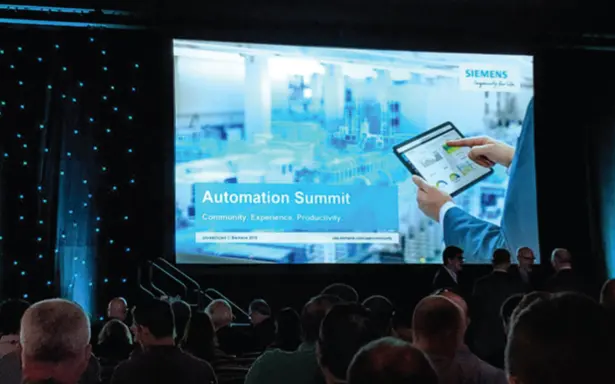
Siemens welcomed more than 700 attendees to this year’s Automation Summit, an annual event held last week at the Gaylord Rockies Resort and Convention Center in Denver, Colorado. Siemens’ objective for the conference is to inspire, enable, and support its customers’ automation initiatives by fostering collaboration among users, third-party solution partners, and Siemens experts. Success stories, shared from the perspective of the customers themselves, enable Siemens to showcase its products’ capabilities in a context not afforded within traditional product documentation and other marketing collateral. Also featuring dozens of live demos and hands-on training sessions, Siemens Automation Summit provided a wide range of learning experiences for all attendees.
From a thematic perspective, digitalization was clearly the primary point of emphasis. Most (if not all) presentations highlighted the various ways in which customers and solution partners have leveraged digitalization to improve operations. Advanced capabilities enabled within the latest versions of Siemens’ distributed control system―SIMATIC PCS 7 and SIMATIC PCS neo―were central to many of these discussions, which also included detailed use-cases for artificial intelligence, augmented reality, digital twins, predictive maintenance, remote services, and more. Presentations detailing techniques and best practices for industrial networking, industrial cybersecurity, and machine safety underscored some of the challenges inherent in operating in increasingly digitalized industrial environments.
While user-focused conferences such as this are relatively common within the automation space, the impact of these events is not insignificant. Siemens and its competitors, collectively, play a critical role in the digitalization of industry and the broader ideal of Industry 4.0. By now, most industrial organizations understand the basic tenets and implications of digitalization and Industry 4.0, but do not fully comprehend exactly how or where it should be implemented. Siemens employs a vast number of experts―spanning a variety of horizontal and vertical segments―that can be called upon to add valuable context, detail, and suggestions to customer projects. Of course, the same can be said for ABB, Honeywell, Rockwell Automation, Schneider Electric, Yokogawa, and other automation leaders. Furthermore, each of these organizations has at its disposal a growing number of solution partners whose technology and expertise can be called upon to fill gaps or add value as necessary. User conferences such as Siemens Automation Summit are critical in bringing each of these elements together, while doubling as effective avenues for the guidance, creative thinking, and leadership of Siemens and other automation suppliers helping to make Industry 4.0 a reality.
Considering the momentum behind Industry 4.0 and the IIoT, expect future user conferences to only get bigger and more impactful, featuring more progressive customer successes and higher profile partner contributions. Personally, I would love to see Amazon, Microsoft, and other cloud providers become more heavily involved in these types of events. IIoT cloud platforms such as Siemens MindSphere have been central to automation leaders’ messaging on the digitalization of industry, and customers would surely benefit from learning first-hand exactly how the major cloud providers would ensure the success of their platform deployments.
To learn more, visit our industrial automation coverage page.