Sensors Expo & Conference 2018, an event focused exclusively on sensors and sensor-integrated systems, took place from June 26th through June 28th at the McEnery Convention Center in San Jose, CA. The exhibition hall featured more than 300 exhibitors from around the world, and was co-located with the Medical Sensors Design Conference and the Autonomous Vehicle Sensors Conference.
This year’s conference featured 10 distinct tracks, each supported by technical sessions, presentations, round table discussions, case studies, and sensor solutions from leading suppliers. Some of the more popular tracks included Designing for the Industrial & Embedded IoT, IoT & Wireless, and Simplifying Complex Sensor Data. Keynotes at this year’s event underscored the emphasis on data and the IoT from within the sensor community. Sensor-Driven 3D Computer Vision and the Future of Human-Machine Interaction (presented by Marc Pollefeys of Microsoft) centered on the role of computer vision and sensors in autonomous vehicles, robots, and other IoT-based applications. Extending Cloud-Native Principles to the Edge to Enable Scalable IoT Solutions (presented by Jason Shepherd of Dell and EdgeX Foundry) covered the importance of effectively collecting, integrating, analyzing, and monetizing the massive volumes of data generated by sensors and other edge devices.
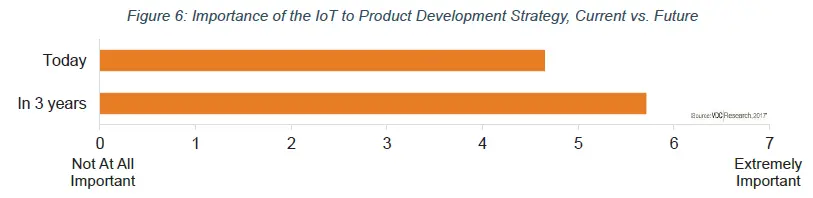
Of course, the emphasis on the IoT is not surprising. In a study VDC conducted last year exploring the IoT phenomenon and its influence on the sensing technologies market, respondents from the engineering community indicated a growing importance of the IoT within their organizations:
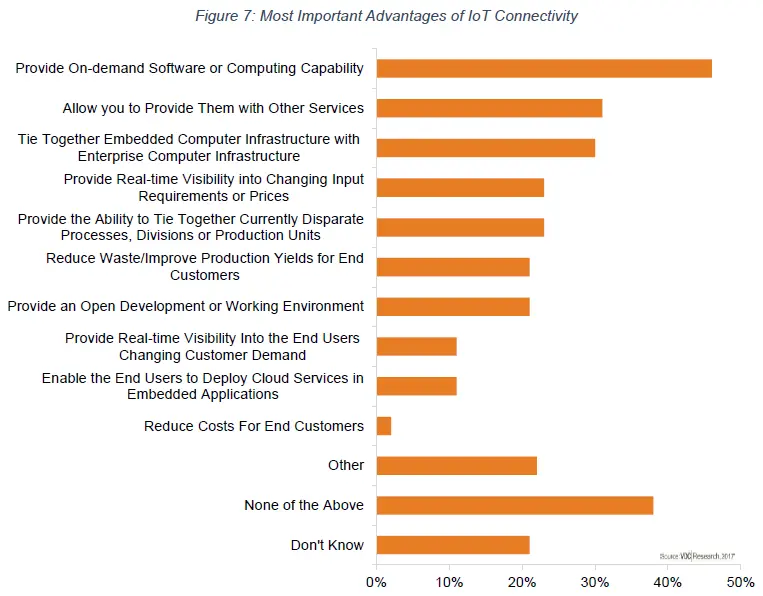
The breadth of attractive benefits enabled by IoT connectivity further emphasizes the vast strategic opportunities that are dependent in no small part upon data gathered by sensors and sensor-enabled devices:
WALKING THE FLOOR
I met with a variety of exhibiting companies and organizations at Sensors Expo & Conference 2018; the following is a brief summary of some of the announcements on which I was briefed and product demonstrations I witnessed while at the show.
Bluetooth Special Interest Group shared various data points detailing the adoption of Bluetooth technology (4 billion projected device shipments in 2018) and membership at Bluetooth SIG (nearly 34 thousand members in 2017), and provided updates regarding Bluetooth mesh networking, Bluetooth 5, and adoption trends in industrial settings.
Dover Microsystems, a hardware-focused cybersecurity firm with origins at DARPA, detailed the cybersecurity strategy behind its CoreGuard technology. CoreGuard, which is licensed to semiconductor designers, aims to enable real-time defense at the processor level. Dover’s product offering has two components: CoreGuard SDK and CoreGuard Policy Enforcer RTL.
Eta Compute, an ASIC company focused on machine intelligence, demonstrated several of its products focusing on energy efficiency and intelligent voice recognition.
Microchip provided an overview of its SAM L10 and L11 microcontrollers. Built on ARM TrustZone technology, these power-efficient 32-bit MCUs feature robust, on-chip security via TrustZone and also include enhanced support for devices with capacitive touch interfaces.
Sensera shared details on its expertise in high-performance sensors and microelectromechanical systems (MEMS), and discussed its corporate vision following its September 2017 acquisition of Nanotron Technologies. Nanotron is a provider of location-awareness products and services.
Standex Electronics displayed a wide range of sensor products, including its Hall Effect Level Sensing and Capacitive Level Sensing solutions.
TDK featured an array of sensor-related products and demonstrations. Among the more prominent displays at TDK’s booth was its InvenSense Motion and Sound Sensor, which is designed to calibrate and sharpen sensor outputs. This solution utilizes various sensors, including accelerometers, gyroscopes, compasses, and microphones, in addition to proprietary algorithms and firmware.
TE Connectivity showcased its broad portfolio of sensors and sensing components, including various force sensors, position sensors, pressure sensors, and much more.
TT Electronics exhibited its vast lineup of rotary position sensors, reflective optical sensors, and other high-performance sensor solutions. TT provided specific details regarding its Photologic V OPB9000 reflective sensor, which is designed for reliability, simplicity and efficiency, and flexibility and versatility.
Xilinx shared details regarding its announcement that Daimler AG had selected Xilinx’s artificial intelligence processing technology for use within future Mercedes-Benz models. The collaboration will center on Xilinx’s SoC-based automotive platform and AI acceleration software.
To learn more about VDC’s coverage of industrial technologies, visit our website or contact us for more details!