Engineering Values are Shifting as Edge AI Applications Mature
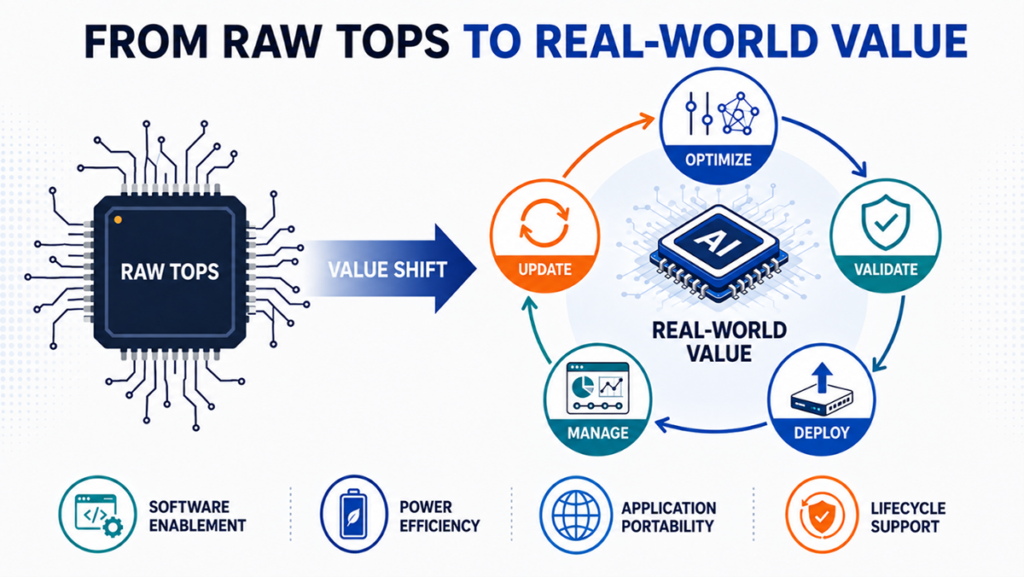
In recent years, the Edge AI industry has shifted from the experimentation phase to full scale production and deployment. With this shift now well under way, we can see where Edge AI is being deployed and what engineering teams value in its current form within the embedded domain. As accelerated computing solutions become more prevalent, differentiation is shifting from general-purpose TOPS performance to application efficiency, lifecycle support, and software enablement.
Edge AI Software Is Becoming the Critical Differentiator, Not Raw Silicon Performance
Product development organizations are starting to implement AI as a standard feature that is not exclusive to high-end products. This widespread use is placing greater weight on architectural efficiency and application portability across hardware platforms, including low-footprint and MCU-class devices. As embedded AI models become more optimized and distributed, while integrated acceleration technologies advance, we will see further demand for versatile software platforms that maximize developer flexibility.
In response to this, expanding software capabilities has been a major point of focus for several leading semiconductor providers. NXP’s introduction of its eIQ Agentic AI Framework and AI Hub, for example, were launched to simplify the deployment and management of edge AI applications across its platforms. STMicroelectronics’ launch of STM32Cube AI Studio and AI Developer Cloud also help streamline model optimization, validation, and deployment/updates across embedded systems. In fact, every leading embedded semiconductor vendor has launched edge AI enablement initiatives filling these capabilities with varying degrees.
The Bigger Picture
The Edge AI industry has entered the next phase of its maturity with engineering values shifting toward ease of deployment, software enablement, power efficiency, and enabling real-world operational value. This trend is only accelerated with the widespread AI enablement as a standard feature not exclusive to only high-performance targets. For embedded AI hardware providers, this means differentiation will increasingly come from software and application enablement as the importance of raw TOPS fades away.
VDC has published various research studies investigating the sectors for both Embedded & Edge AI Hardware as well as AI Development Solutions. See our 2026 Research Outline to learn more about our planned Edge AI coverage for this year.