Talking About Your Product Is The Best Way To Kill A Deal
Companies exist to solve customer problems. That’s the foundation of every successful business, and it should be the foundation of every sales conversation. Yet most sales training in industrial and operational technology companies starts in the same place: the product. That’s exactly where deals go to die. When salespeople lead with features, specs, and configurations, they reduce a strategic business decision to a technical comparison, and the consequences extend far beyond a single conversation. Deals stall as customers struggle to build internal consensus around value they were never shown. Opportunities shrink, margins erode into price comparisons, and salespeople lose access to the senior stakeholders who actually own the outcomes. Many deals don’t fail because the product was wrong. They fail because the customer was never given a reason to act.
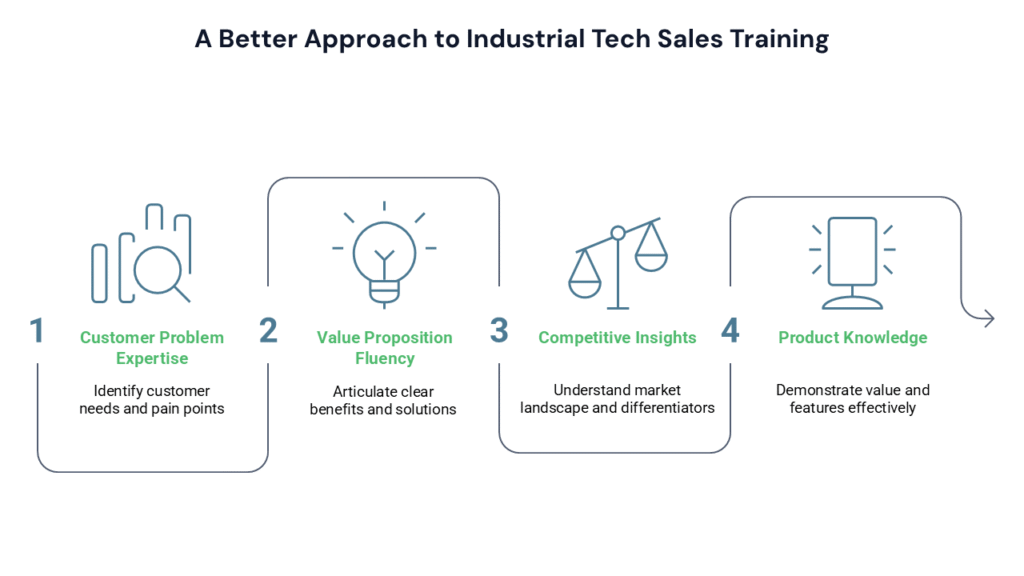
A far better approach begins by taking a big step back and conducting structured research and analysis to define a clear, customer-grounded value proposition, examining customer challenges independently of any specific product or solution. That value proposition then becomes the foundation for how sales teams are trained to engage. Product training still has an important place in the process, but it comes last, after the sales team is expert at understanding the customer problem and the company’s value proposition related to that problem.
Companies exist to solve customer problems. That should be the foundation of every sales conversation, yet most sales training starts, and often ends, with the product instead.
Sales teams are typically taught features, specifications, configurations, and competitive comparisons first, with the assumption that deep product knowledge will naturally translate into stronger sales performance. It’s logical on the surface. In practice, it misses the mark. Product knowledge matters, but when it’s the starting point rather than the closing layer, it shapes every conversation around the wrong center of gravity.
In complex sales environments, customers are forced to understand products in order to determine whether those products actually solve their problems. That’s a burden the seller should be carrying, not the buyer. Customers aren’t trying to understand products for their own sake. They’re trying to solve problems, reduce risk, and achieve specific operational and business outcomes. When sales teams lead with the product, they force the customer to connect the dots between features and value. Many customers don’t do that work, or do it inconsistently, leading to stalled deals, smaller opportunities, and decisions driven by price rather than impact.
Start With the Customer, Not the Product
The right approach starts from a different premise: before a salesperson can effectively position any solution, the organization must deeply understand the customer’s pains and desired gains without framing them through the lens of existing products or services. This requires a deliberate effort to separate the problem from the solution, and to resist the temptation to jump into product training before that foundation is in place.
That understanding comes from structured customer research that explores how organizations operate today, where inefficiencies and bottlenecks exist, what pressures stakeholders are under, and what outcomes they’re ultimately trying to achieve. Studying the customer environment independently uncovers a more objective and complete picture of the problem, often revealing issues and opportunities that a product-first analysis would miss entirely.
This customer-centered insight becomes the foundation of the value proposition, and in turn the foundation of effective sales training. Instead of starting with “what the product does,” the starting point becomes “what the customer is trying to achieve.” Salespeople learn to diagnose before they prescribe, ask better questions, and identify the underlying drivers of a customer’s needs rather than just reacting to stated requirements. They become fluent in the language of operations, finance, and risk before they become fluent in the language of the product.
The question isn’t whether to train sales teams on the product. It’s when. Product training belongs last, after the customer and value proposition are understood.
Position the Product as a Means to an End
Only then does the product enter the conversation, and this is where rigorous product training belongs. Sales teams still need to know the product deeply, including its capabilities, configurations, and competitive positioning. But that training lands very differently when it comes last. Instead of being a catalog of features to memorize, the product becomes a toolkit that salespeople already know how to map to specific customer problems. It’s positioned as a means to an end: a way to reduce downtime, improve throughput, lower costs, or mitigate risk. The focus shifts from describing what the product is to demonstrating what it enables. Product knowledge still matters, but it’s applied selectively, based on what’s most relevant to the customer’s situation.
The Impact: Faster Deals, Bigger Opportunities
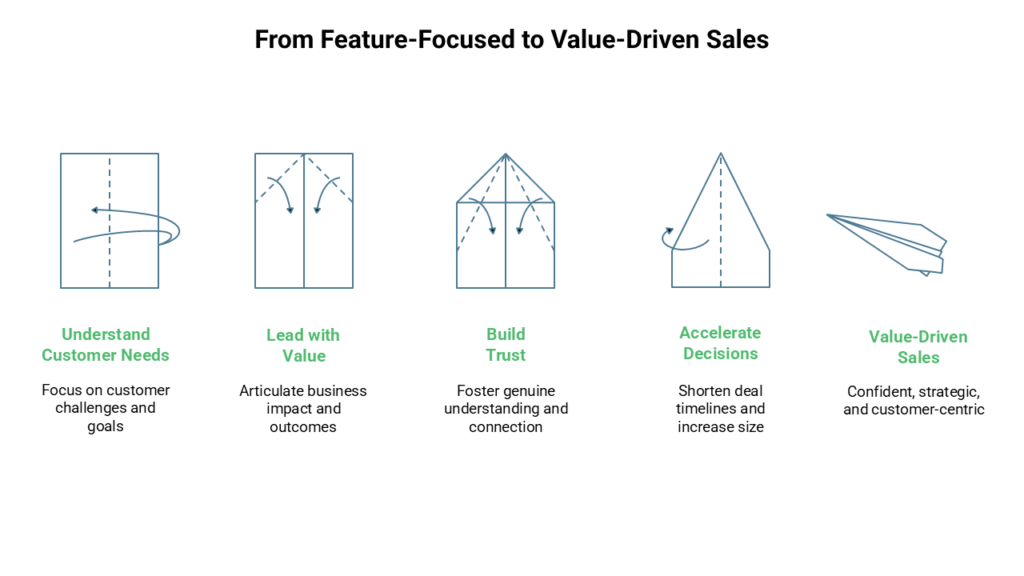
The impact is significant. When sales teams lead with value, customers feel understood, which builds trust early. Conversations become more focused and meaningful, making it easier to differentiate from competitors still leading with features. That clarity accelerates decision-making and shortens deal timelines.
Deal sizes increase too. When conversations are anchored in outcomes, they naturally expand. Sales teams are better equipped to identify additional use cases, broader applications, and higher-value opportunities that a product-centric approach would miss. Instead of selling a single component, they position a comprehensive solution aligned with the customer’s broader objectives, drawing on their product knowledge to assemble the right answer rather than leading with it.
There’s also a less obvious but equally important effect: confidence. When salespeople truly understand their customers’ challenges and can clearly articulate the business impact, they stop relying on memorized pitches. They adapt in real time, guide more strategic conversations, and engage credibly with a wider range of stakeholders. Customers sense that shift immediately.
From Vendor to Trusted Advisor
Something else happens too, and it changes the relationship entirely. When a salesperson’s primary focus is helping the customer solve real business problems, they stop being perceived as a vendor and start being seen as a trusted advisor. There’s an old truth in complex sales: salespeople get delegated down to the people they sound like. Sound like a product spec sheet, and you end up across the table from a junior buyer comparing line items. Sound like someone who understands the business, and you stay in the room with the executives who own the outcomes. Customers bring trusted advisors into conversations earlier, share more openly about their challenges, and look to them for guidance rather than just pricing. That kind of relationship is extraordinarily difficult for competitors to displace. It’s not built on a product feature or a contract term. It’s built on the belief that the salesperson is genuinely invested in the customer’s success.
Salespeople get delegated down to the people they sound like. Sound like a spec sheet, and you end up across from a junior buyer.
The Future of Industrial & Operational Tech Belongs to Customer-First Sales Teams
As industrial and operational technology markets evolve, sales complexity is only increasing. Buying groups are larger, ROI expectations are higher, and differentiation is harder to achieve. Product knowledge alone is no longer enough, but it’s still essential. The question isn’t whether to train sales teams on the product. It’s when. The companies that win are those whose sales teams can clearly and convincingly connect what the customer is experiencing, what they’re trying to achieve, and how a solution delivers measurable value, and who layer product expertise on top of that foundation rather than under it.
Shifting to a value-proposition-oriented approach isn’t a refinement of the traditional model. It’s a fundamental rethinking of the sequence in which effective selling is built. Customer understanding first, value proposition next, product training last. For organizations willing to make that shift, the rewards are tangible: higher win rates, faster deals, and stronger customer relationships.