At A Glance
Physical AI is AI At The Edge – Physical AI is artificial intelligence that runs on the billions of edge devices at the interface between the digital and physical worlds, letting machines sense, decide, and act at the speed of reality.
The Opportunity Touches Nearly All of Global GDP – Physical AI is a multi-trillion-dollar opportunity to bring intelligence to the billions of machines, vehicles, and devices that run the real-world economy.
The History of Managing Industrial And Operational Technology Has Been Reactive – Traditional industrial and operational processes relied on humans responding to data, notifications, alarms and failures after the fact, making operations slow, costly, and dependent on people being in the right place at the right time.
Physical AI Flips the Script to Autonomous Proactive Management – AI is no longer just an analytical tool; it is becoming the real-time operator of physical systems across energy, manufacturing, telecom, transportation, and more.
The Data Is There to Enable The Physical AI Transition – Industrial and operational environments produce massive amounts of sensor data, but most of it was historically ignored or discarded because humans couldn’t process it at scale.
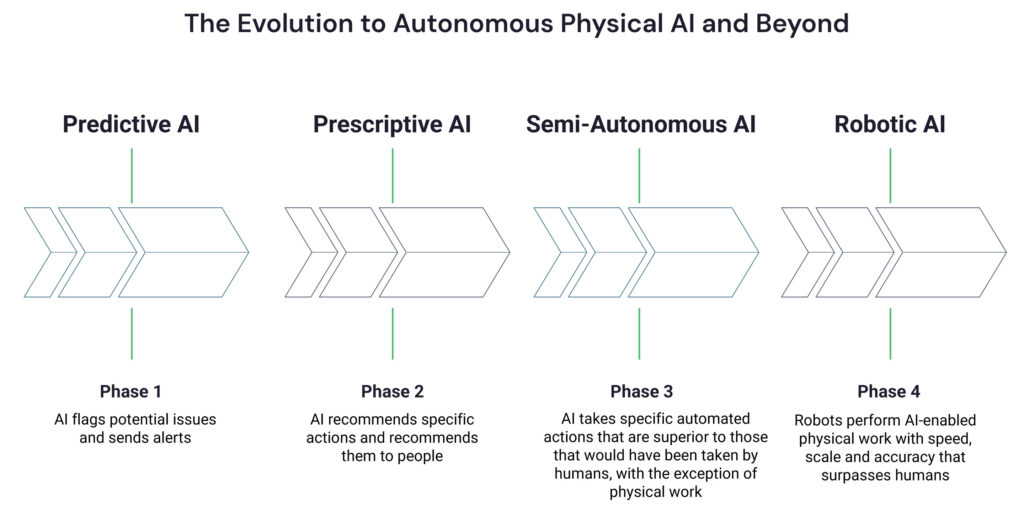
The Evolution Toward Physical AI Will Follow A Logical Trajectory:
- Predictive – Flags what is likely to fail and when
- Prescriptive – Recommends specific actions and auto-generates work orders
- Semi-Autonomous – Acts independently, rerouting systems, ordering parts, and dispatching technicians without human input
- Robotic – Physical tasks previously handled by humans are performed better and faster by AI-enabled robots
The ROI Offered by Physical AI Is Clear And Compelling – Physical AI reduces service calls and truck rolls, cuts unplanned downtime, optimizes productivity, minimizes energy consumption, and improves product quality and yield, along with countless other benefits that can be quantified and are material.
The Human Role Evolves, Not Disappears – Workers will shift from reactive, low-complexity tasks to high-judgment work, model training, and oversight of AI decisions.
It’s Happening Now – Firms are already deploying autonomous Physical AI in production environments today, but the potential is enormous and nearly entirely untapped.
Physical AI Puts AI At The Edge of The Physical and Digital Worlds
While the AI most people know runs in distant data centers, answering questions and generating images from the cloud, Physical AI operates where the action actually happens: on the device, at the edge, in the moment. It drives cars, pilots drones, stocks warehouses, performs surgery, and walks on two legs through factories and homes. Instead of mastering only language and pixels, it has to reckon with the stubborn unpredictability of the real world, often with milliseconds to decide and no round trip to the cloud to spare. Running intelligence on the edge, close to sensors and actuators, is what lets machines perceive and respond at the speed of reality. In short, Physical AI is the moment intelligence stops being a conversation in the cloud and starts being a presence in the room. Machines that don’t just think, but sense, decide, and do.
The Physical AI Opportunity Touches Most of Global GDP
The scope of the Physical AI opportunity dwarfs what we typically think of as the AI market. Traditional AI, for all its recent momentum, is ultimately bounded by screens and servers: it competes for attention in browsers, productivity apps, and enterprise software, a market measured in the hundreds of billions of dollars. Physical AI, by contrast, reaches into the trillions, because it touches everything that moves, senses, or operates in the real world. Cars, factories, warehouses, hospitals, farms, homes, and cities are all candidates for intelligent automation, and the installed base is already enormous: billions of cameras, sensors, vehicles, appliances, and industrial machines are waiting to be upgraded from dumb hardware into adaptive, learning systems. Where traditional AI makes knowledge workers more productive, Physical AI transforms the physical economy itself, which represents the vast majority of global GDP. In other words, traditional AI is rewriting how we work with information, while Physical AI will rewrite how the world actually runs.
Consider just one example: global agriculture. The world farms roughly 5 billion acres of land and raises tens of billions of animals each year to feed a population of over 8 billion people. Physical AI is poised to touch every layer of this system, from autonomous tractors and crop-scouting drones to livestock tracking, precision irrigation, and computer-vision systems that monitor the health of individual plants and animals. Lifting yields or reducing inputs by even a few percent across an industry that already represents trillions of dollars of output, and underpins the food supply of the entire planet, is a staggering prize, and it is only one slice of what Physical AI will reshape.
Flipping The Script – AI As The Operator
Physical AI is no longer just a tool for analyzing data after the fact. It is becoming the operator, watching, reasoning, deciding, and acting in real time on the physical world. For decades, operations teams relied on dashboards, alerts, and human judgment to keep complex systems running. Physical AI inverts that model, placing intelligent systems inside the loop itself, continuously ingesting signals from sensors, networks, and machines, and taking action the moment conditions demand it. A power grid can reroute load before a line fails. A factory can adjust a production run the instant a defect pattern emerges.
At VDC Strategy, we believe this shift represents one of the most significant transformations in industry and business operations in a generation. It changes who, or what, is at the controls of the physical economy, along with the skills operations teams need, the vendors they buy from, and the architectures they build on. The companies that master Physical AI will run faster, cheaper, and more reliably than those still relying on human reaction time and retrospective analysis. The era of AI as a back office copilot is ending. The era of AI as the operator has begun.
The Data Was There But The Intelligence Was Missing
Industrial and operational environments are extraordinarily data rich. A modern oil refinery, for example, generates terabytes of data per day. For most of industrial history, the vast majority of this data went uncollected. Then, for many decades, it was collected but went largely unexamined, either discarded immediately or stored in silos where it quietly aged into irrelevance. Human operators simply couldn’t process it at scale. They managed by exception, waiting for a threshold to breach, a light to flash, a system to fail, and then they responded.
The problem with managing by exception is that exceptions are expensive. By the time an alarm fires, you’ve already lost something: uptime, product quality, energy efficiency, equipment life. You’re no longer preventing a problem. You’re cleaning one up.
Physical AI changes this fundamentally. Modern machine learning models, trained on historical operational data, real-time sensor streams, weather feeds, maintenance logs, and more, can detect patterns that precede failures long before any human-set threshold is crossed. They don’t just see what’s happening. They understand what it means.
Physical AI – From Predictive to Prescriptive to Semi-Autonomous to Robotic
Physical AI will evolve through four phases, and leading organizations are currently moving into the third of the four phases, sometimes leapfrogging over the prior ones.
The first phase is predictive and has been commercially available for at least a decade: Physical AI flags what is likely to go wrong and when. A compressor on a gas pipeline shows vibration harmonics consistent with early-stage bearing wear. The model predicts failure within fourteen days and sends an alert. A human decides what to do.
Physical AI is no longer just a tool for analyzing data after the fact. It is becoming the operator, watching, reasoning, deciding, and acting in real time on the physical world, and represents one of the most significant transformations in industry and business operations in a generation.
The second phase is prescriptive: Physical AI doesn’t just flag the problem, it recommends the action. Same compressor, same prediction, but now the system cross-references maintenance schedules, spare parts inventory, technician availability, and the cost of unplanned downtime versus planned maintenance. It recommends a specific intervention window and generates the work order automatically.
The third phase is autonomous: Physical AI takes action. The system reroutes flow away from the suspect compressor, adjusts upstream pressure to compensate, schedules the maintenance window, orders the part, and dispatches the technician, all without a human making a single decision. The human reviews a summary the next morning.
In the fourth phase, the repair is performed by an autonomous robot with knowledge, skills, availability, and precision that exceeds that of a human. The human maintains and supervises the fleet autonomous repair robots just as they would any other physical asset. While this final phase of the evolution might be viewed as unsettling by some, we believe this is inevitably where we are headed.
Today, we are transitioning into the third phase in industries ranging from oil and gas to semiconductor fabrication to grid-scale energy storage. In VDC Strategy’s view, the organizations investing in this third phase now are the ones that will define operational benchmarks for the rest of the decade. And the innovators developing these solutions are the ones who will set the course for the future of industrial and operational technology.
The Economics of Physical AI Are Undeniable
Physical AI is poised to deliver a step-change in how virtually every industry operates. On the production side, it means higher quality and yield, with tighter tolerances, real-time inspection of every unit rather than statistical sampling, and reductions in scrap, rework, and defects. It means more efficient use of every input that goes into a product, from raw materials and chemicals to water and energy, with tighter process control translating directly into lower cost per unit and a lighter environmental footprint. It reshapes the labor equation as well, letting organizations redeploy people to higher-value work, reduce their dependence on scarce skilled trades and a shrinking workforce, and run extended or lights-out operations without proportional hiring. And it makes work safer, pulling humans out of repetitive, heavy, and hazardous tasks and lowering the injury rates, and insurance costs, that come with them.
The benefits extend well beyond the factory floor. Physical AI drives higher uptime and overall equipment effectiveness through predictive maintenance, fewer and more efficient service calls, and remote diagnostics that get the right technician to the right asset with the right part on the first visit. It makes operations faster and more flexible, enabling quicker changeovers, shorter production runs, economical mass customization, and supply chains resilient enough to make reshoring viable again. Perhaps most importantly, it generates continuous, high-fidelity data from the physical world, data that fuels better traceability, real-time visibility into previously opaque processes, and a compounding loop in which every hour of operation makes the next one smarter. The result is a new economic equation defined by lower total cost of ownership, higher capital productivity, faster time to market, and entirely new products and business models that simply weren’t feasible before. Taken together, physical AI isn’t just an efficiency upgrade. It’s the foundation for a more productive, more sustainable, and more resilient global industrial economy.
The Human Role Will Evolve
There is an understandable anxiety about what Physical AI means for the workforce. If Physical AI is the operator, what is the human? The honest answer is: better deployed.
The technicians who currently spend their days responding to false alarms, driving to sites for routine checks, and performing low-complexity interventions can instead focus on high-complexity work that genuinely requires human judgment, creativity, and hands-on skill. They become reviewers of Physical AI decisions, trainers of Physical AI models, and handlers of the exceptions that the system correctly escalates. Their expertise doesn’t become obsolete. It becomes the foundation on which Physical AI is built and refined.
The business case for Physical AI does not require a leap of faith. Truck rolls, unplanned downtime, and wasted energy are significant operational expenses in asset-heavy industries, and Physical AI addresses all three, and many more.
The organizational shift is real and requires deliberate management. It demands investment in training, in change management, and in governance frameworks that define when Physical AI acts autonomously and when it defers to human judgment. The organizations that navigate this well will find that their people are more engaged, not less, because they’re solving harder problems. VDC Strategy consistently sees this pattern with the industrial clients we work with: the workforce question is not whether Physical AI displaces people, but how leadership chooses to redeploy them.
The Shift to Physical AI Is Already Underway
Across the industrial landscape, the shift to Physical AI adoption is accelerating. Utilities are using it to balance grid loads and detect equipment anomalies before outages occur. Oil and gas operators are running Physical AI-driven well optimization that adjusts production parameters continuously without human input. Manufacturers are deploying Physical AI vision systems that catch defects in real time and adjust process parameters on the fly. This is not a future state. Physical AI is the present, unfolding unevenly but unmistakably across every sector that operates physical infrastructure at scale.
The organizations that treat Physical AI as a strategic priority today will compound significant advantages over the next decade, in cost, reliability, safety, and the capacity to operate at a scale that would be humanly impossible. Those that wait will find themselves managing the same costs, the same truck rolls, and the same reactive cycles, while their competitors operate leaner, faster, and smarter.
The physical world is generating more data than ever before. For the first time in history, Physical AI gives us the intelligence to act on it. That changes everything. VDC Strategy is committed to helping the innovators in industrial and operational technology lead in this new era of operations.
How VDC Strategy Can Help
We work exclusively with industrial and operational technology companies at the moments when strategic decisions matter most. When entering new markets, shifting business models, evaluating acquisitions, or navigating competitive disruption, informed decision-making is essential.
We help tech leaders separate probability from magnitude, distinguish execution risk from strategic risk, and build mitigation strategies that address both dimensions. We bring a combination of deep market knowledge and strategic rigor that most leadership teams don’t have sitting inside their organizations.
If your team is working through a high-stakes strategic decision and wants a more disciplined framework for evaluating the risks and opportunities involved, reach out to us to learn more.