The Value Proposition Gap
Your company has a competitive weapon it already owns but likely almost never fires. It’s your value proposition, and it’s likely just sitting in its holster.
Most industrial and operational technology companies know exactly what they sell and exactly who they sell it to. Nearly every sales leader can show you detailed product specifications, well-defined target markets, segmented customer lists, and sales teams that can talk about features, configurations, integrations, and APIs with real fluency. That’s the easy part, and most companies have it covered.
Most industrial tech companies
know what they sell and who
they sell it to. The biggest
opportunity lies in building deep,
company-wide insight into the
customer problem they solve, the
measurable outcomes they
deliver, and how they are
uniquely differentiated with proof.
But ask the same sales team to go deep on the core of their value proposition, namely the specific customer problem they solve, the measurable outcomes they deliver, or how they are uniquely differentiated from competitors with credible proof points, and the answers tend to get thinner. The statements become more generic, less consistent across the team, and less grounded in evidence. That difference points to one of the largest sources of untapped revenue and margin in industrial tech. The product was never the issue; the opportunity lies in giving the customer a compelling reason to act, a clear picture of what they stand to gain, and real confidence that one provider is meaningfully different from the alternatives.
There is real opportunity hidden inside that gap. When much of the field sounds generic and unsupported, a sales team that can clearly articulate the problem, quantify the outcome, and back up its differentiation will tend to stand out, and close larger deals, at better margins, faster.
Closing the value proposition gap is a leadership responsibility. It’s leadership’s job to develop these three elements of the value proposition, train the sales team on them, and hold the team accountable for using them in every customer conversation. The required investment is minor compared to the impact on business performance, and because so few competitors are willing to do the work, the advantage you build is one your competitors are unlikely to copy.
The Value Proposition Pyramid
At VDC, we’ve developed the Value Proposition Pyramid to make the concept concrete. It has five layers, each one building on the one below it.
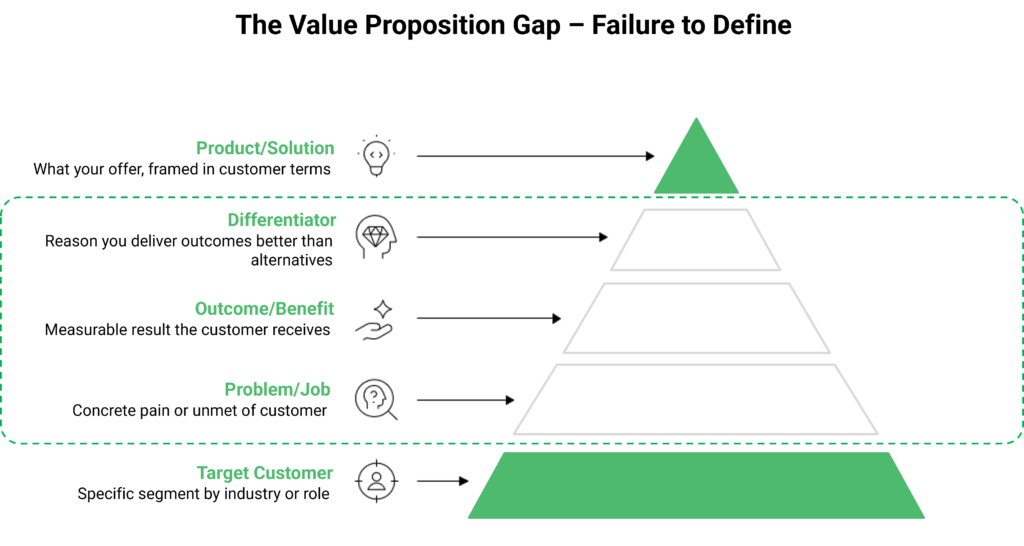
- Target Customer: the specific segment, defined by industry or role, that you are setting out to serve. Everything above it depends on getting this right, because value only means something in relation to a particular customer.
- Problem/Job: the concrete pain point or unmet need that customer is trying to address. This is the reason they would consider buying anything at all.
- Outcome/Benefit: the measurable result the customer actually receives when that problem is solved.
- Differentiator: the reason you deliver that outcome better than the alternatives a customer could choose instead.
- Product/Solution (the tip): your offering described in the customer’s terms rather than your own.
The real mass of a value proposition lives in the three middle layers: the problem, the outcome, and the differentiator. That middle is where you explain why a customer should care, what they stand to gain, and why they should choose you over someone else. It is the part that does the persuading.
And it is precisely the part with the most room left to develop. Most companies define the top and the bottom with confidence, then treat the middle as if it were self-evident, which means the section that carries the most selling power is also where the greatest gains are still available.
The Definition Gap
The reason most companies have yet to capitalize on their value proposition is refreshingly simple: the work of defining and communicating the critical middle layers is still waiting to be done. Articulating the precise problem a customer faces, the measurable outcome they receive, and the credible reason you deliver it better than anyone else is hard, disciplined work. It requires research, analysis, and the willingness to make sharp choices about what you are and aren’t. Because it’s demanding and rarely urgent, it tends to get deferred in favor of more pressing priorities, which is exactly why the opportunity remains open for the companies willing to do it.
What makes this gap so persistent is that leadership rarely feels its absence. The people running the business are usually strategic thinkers by nature, and many have been with the company for years or decades, absorbing its value through osmosis until it feels like second nature. They genuinely do understand why customers buy, what sets the company apart, and what outcomes it delivers, so they assume the rest of the organization understands it too. Because it’s self-evident to them, they conclude it must be self-evident to everyone, and the need to write it down never registers.
The middle layers of the value
proposition rarely get defined
because leadership understands
them intuitively, assumes
everyone else does too, and
believes the work is already done.
Compounding the problem, leadership often believes the work has already been done. Ask a leadership team whether they’ve defined their value proposition and most will say yes, pointing to a tagline, a pitch deck, or a strategy offsite from a few years back. But on closer inspection, what they have is a loose, intuitive understanding rather than a precise, shared definition. The pieces live in their heads, articulated differently by different executives. The result is a dangerous blind spot: a team convinced its value proposition is settled, while the sales force in the field is left to improvise the very elements that matter most.
The Adoption Gap
Even when a company does the work to define its value proposition, the job is only half finished. The reality is that real fluency across the organization takes time and structured training. Internalizing the customer’s problem, the measurable outcomes, and the proof behind your differentiation isn’t a matter of a single kickoff slide or an all-hands mention. It requires repetition, practice, real examples, and the chance to rehearse the language until it becomes second nature in a live customer conversation. Anything less leaves reps with a vague awareness of the value proposition rather than the command they need to wield it.
And training alone still isn’t enough, because adoption is fundamentally a matter of behavior change. People revert to old habits unless new ones are reinforced, which means leadership has to measure whether the value proposition is actually being used and hold the team accountable for using it. That requires building it into call reviews, deal qualification, sales enablement, and coaching conversations, so that articulating the problem, quantifying the outcome, and proving differentiation become standard practice rather than the exception. Without measurement and accountability, even a well-defined, well-trained value proposition quietly fades back into the generic pitch it was meant to replace, and never becomes part of the organization’s DNA.
What The Research Shows
To understand where the greatest upside in value propositions lies, we surveyed 141 non-sales leaders from across industrial and operational technology companies. The results point to a consistent and encouraging pattern: sales teams are already well-versed in the product itself, and the elements of the value proposition that actually win deals are exactly where the most headroom remains.
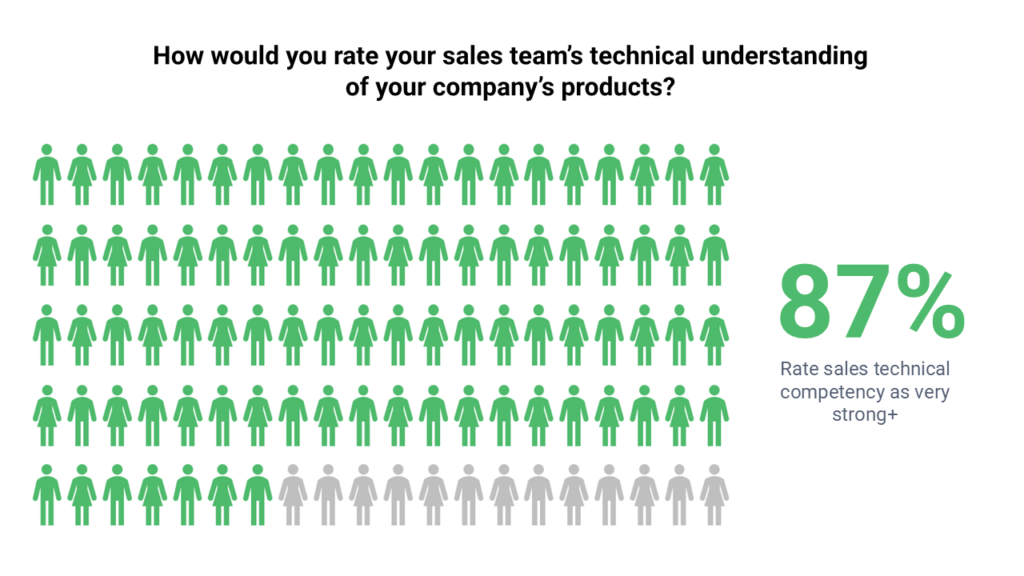
On the product, the picture is strong. A full 87% of leaders rate their sales team’s technical understanding of the company’s products as very strong or better. This is the dimension companies invest in most heavily, and it shows. But technical fluency turns out to be the easy part, and the easy part is not what closes business.
Sales’ Technical Understanding Is Usually Strong
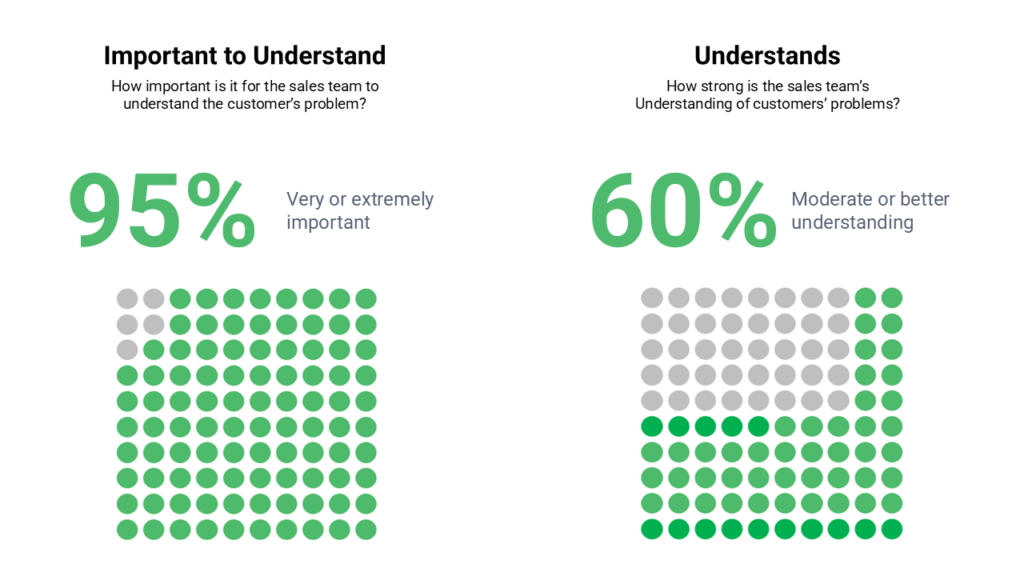
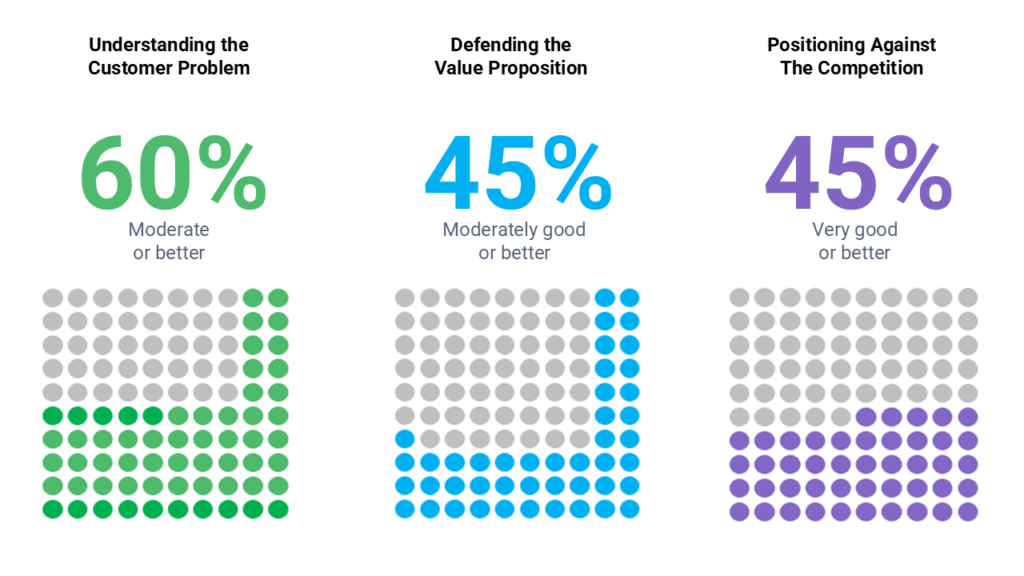
The opportunity comes into view the moment the focus shifts from the product to the customer. While 95% of leaders say it is very or extremely important for sales to understand the customer’s problem, 60% believe their team already has a moderate or better grasp of it. That distance, between how critical the skill is and how much room remains to build it, is where the upside lives.
Understanding the Customer Problem Is the Clearest Opportunity
The same opportunity extends to the value proposition itself: 52% of leaders feel their company has done a moderately good or better job defining and documenting it, and 45% feel their sales team is moderately good or better at defending it, leaving meaningful ground to gain on both fronts.
Defining and Defending the Value Proposition Is Where Deals Are Won
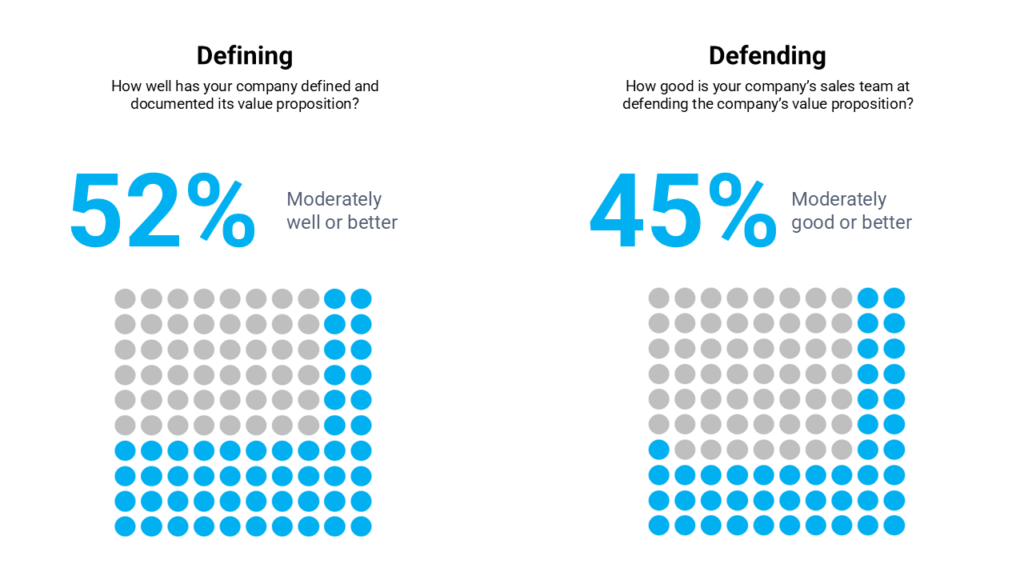
The two are connected. A value proposition that was never clearly defined is one the sales team has little hope of defending.
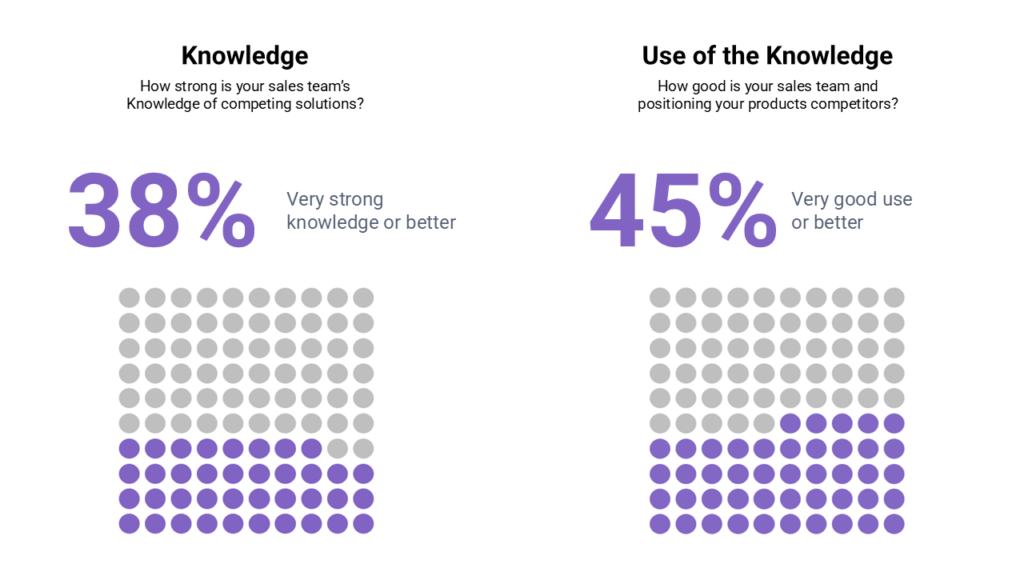
Competitive understanding is weaker still. Only 38% of leaders rate their sales team’s knowledge of competing solutions as very strong or better, and just 45% feel the team puts whatever knowledge it has to good use in positioning against competitors. When this expertise is missing, the customer often ends up understanding your solution and your competitors better than your own sales team does. Whoever understands the landscape best frames the comparison, and if that’s a competitor, your rep walks in already behind, anchored to someone else’s story.
Competitive Knowledge Is the Largest Untapped Edge
Taken together, the survey points to three high-value skills with the most room to grow: understanding the customer’s problem (60% moderate or better), defending the value proposition (45% moderately good or better), and positioning against the competition (45% very good or better). These are precisely the skills that, once strengthened, do the most to lift value and margin.
Taken Together, Sales Lacks The Skills to Maximize Value and Margin
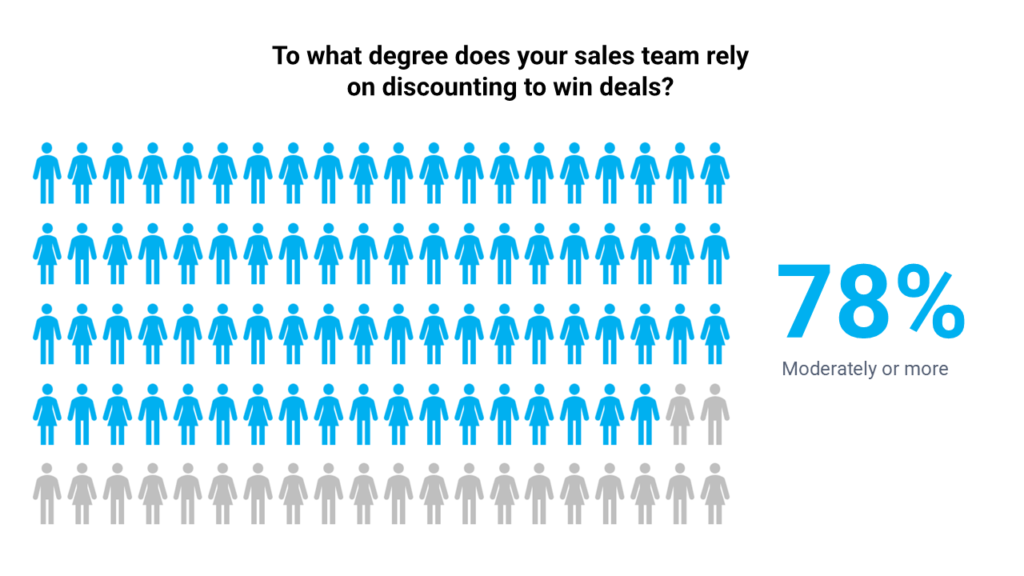
The payoff from building these skills is just as clear. When sales can articulate the problem, defend the value, and differentiate against rivals, it no longer has to fall back on price. Today 87% of leaders say their sales team relies on discounting moderately or more to win deals, which means much of that margin is recoverable, and a great deal of value is waiting to be captured deal after deal.
Stronger Value Skills Reduce the Need to Discount
Industrial Tech – Where The Value Proposition Matters Most
A sharp value proposition matters in any business, but in industrial and operational technology it moves from helpful to essential. That’s because these businesses tend to share a specific set of characteristics, and each one raises the stakes on getting the value proposition right.
Start with the market itself. Industrial and operational tech markets are typically crowded, with many capable vendors chasing the same accounts, and crowded fields breed me-too claims, where every competitor insists they’re faster, more reliable, and more flexible than the rest. When everyone says the same thing, the words stop meaning anything, and a clearly articulated, well-defended value proposition becomes the only way to stand apart from the noise. Without it, you blend into a sea of sameness and hand the buyer no reason to choose you beyond price.
Buyer demographics and psychographics compound the challenge. Customers in these segments are sophisticated and increasingly outcome-driven: they don’t want a feature list, they want evidence of the measurable result they’ll receive. That makes a vague pitch not just unpersuasive but disqualifying, because a knowledgeable buyer can tell immediately when a rep doesn’t truly understand their problem or can’t quantify the value on offer. Meeting them requires a value proposition built on specific outcomes, not generalities.
The offerings themselves raise the bar further. Industrial and operational tech products are often complex, with capabilities and trade-offs that aren’t self-evident. Complexity demands translation, and the value proposition is what turns an intricate technical solution into a clear story about what the customer gains. Absent that translation, even a superior product can lose to a simpler-sounding alternative.
Finally, the economics make all of this urgent. These businesses are frequently premium-priced, and their margins depend on the outcomes they deliver rather than on competing at the bottom of the market. A premium price can only be defended with a premium, credible value story. When that story is missing, the only way left to win is to discount, which erodes the very margins the business is built on. Put together, these characteristics explain why the value proposition isn’t a marketing nicety in this sector. It’s the central mechanism for winning deals and protecting profitability.
The Value-Based Approach to Weaponizing Sales
Closing the gap requires building four competencies in a deliberate sequence, each one laying the foundation for the next. The order matters as much as the content, but so does the depth: the first three stages demand genuine, deep expertise, not the surface-level familiarity most sales teams settle for.
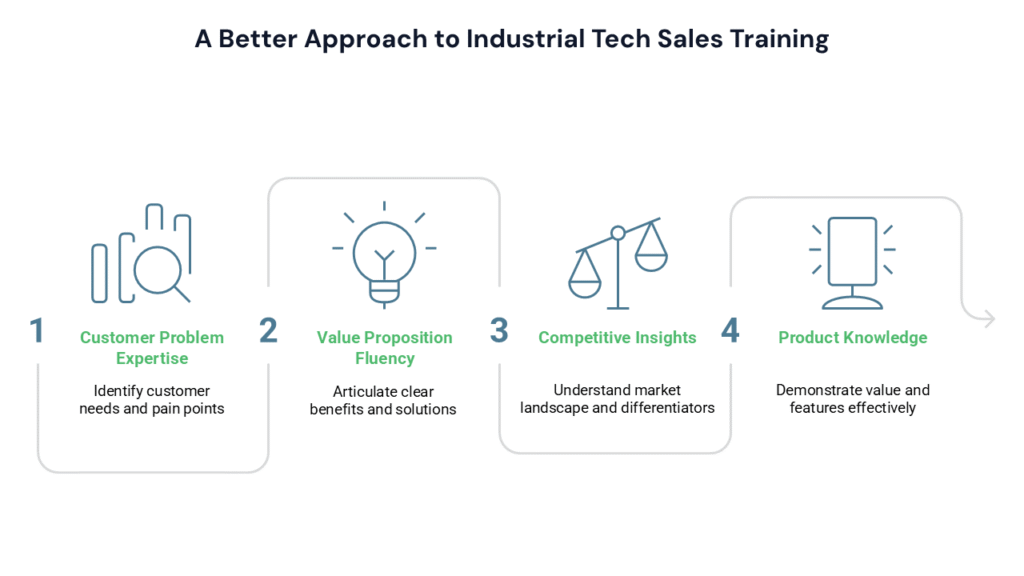
It begins with Customer Problem Expertise: a deep, nuanced understanding of the customer’s real needs and pain points. It isn’t enough to recite a generic list of industry challenges; a rep has to grasp the problem the way the customer actually experiences it, in detail. Until they understand it at that level, nothing else they say can be anchored to anything the customer truly cares about. With the required level of understanding, the conversation can start where it should, in the customer’s world rather than the company’s product.
From there, the focus shifts to Outcomes Competency: a command of the measurable benefits the solution delivers. Surface-level claims that a product “saves time” or “reduces cost” won’t move a sophisticated buyer. A rep needs to connect a specific, well-understood problem to a quantified result, with enough fluency to defend the numbers under scrutiny. This is the step that moves the conversation from features to value, and it depends entirely on having diagnosed the problem deeply first.
The third stage is Competitive Insights: a deep understanding of the market landscape and the differentiators that set the company apart. A vague sense of who the competitors are isn’t enough. A rep has to know how rival solutions actually perform and where they fall short, in real detail, so they can explain not just that they deliver an outcome, but why they deliver it better than the specific alternatives the customer is weighing.
Finally, the rep arrives at Product Knowledge: the ability to demonstrate the product’s value and features effectively. Notably, this comes last rather than first, a deliberate reversal of how most companies train. Product details land with far more force once they are framed by a deeply understood problem, a quantified outcome, and a credible point of differentiation. Sequenced this way, the product stops being the opening pitch and becomes the proof point that ties the value proposition together.
The Competitive Advantage Hiding in Plain Sight
In our experience, the benefits of a value-centric approach are significant. Deals move faster because customers can build internal consensus more easily when the problem, the outcomes, and the differentiation are clear. Deal sizes grow because conversations anchored in outcomes naturally expand into adjacent use cases. Margins hold because the conversation isn’t reduced to a price comparison. And win rates improve because the sales team is engaging on terms that favor them rather than competing on terms set by competitors or procurement teams.
There’s a critical relationship dimension too. Sales teams that lead with the customer’s business get access to senior stakeholders who own the outcomes. Sales teams that lead with the product get delegated to the technical buyers comparing line items. The old truth still holds: salespeople get delegated down to the people they sound like. Sound like a spec sheet, you end up across from a junior buyer. Sound like someone who understands the business problem and can prove the outcomes, you stay in the room with the executives.
Salespeople get delegated
down to the people they
sound like. Sound like a spec
sheet, you end up across
from a junior buyer.
Where Leadership Should Start
For leaders looking to close this gap, the path is not complicated but real work is involved. Start with structured customer research that defines the problem your company solves in the customer’s terms, not yours. Build a quantified outcomes library, grounded in your own customer base, that the sales team can use with confidence. Develop honest, evidence-backed differentiation against the competitors you actually encounter most often. Train the sales team on all three until they can use the content fluently. Then build the accountability mechanisms, deal reviews, coaching cadences, and forecasting discipline that ensure the content actually shows up in customer conversations.
This is not a quick fix or a refinement of existing sales enablement. It is a deliberate investment in the elements of the value proposition that most industrial tech companies under-develop, and it has to be led from the top. The companies that make this investment will find themselves competing on dramatically more favorable terms. The ones that don’t will keep losing deals they should have won, and they will keep wondering why a strong product and a clear target market aren’t translating into the growth they expected.
Product and market knowledge get you to the table. Customer problem, measurable outcomes, and differentiated proof are what win the deal. Industrial and operational tech leaders who recognize that, and who do the work to arm their sales teams accordingly, will build a competitive advantage that is genuinely hard to displace.