California’s Assembly Bill 660 (AB 660), which took effect on July 1, 2026, may appear to be a simple labeling change. By replacing confusing consumer-facing date labels such as “Sell By” with standardized terms like “BEST if Used By” and “USE By,” the legislation aims to reduce consumer confusion and unnecessary food waste. For food manufacturers, brand owners, and the coding and labeling ecosystem, VDC believes this is part of a broader shift toward modernized labeling, improved traceability, and required adherence to more complex compliance requirements.
Food waste is driving (fragmented) regulatory change
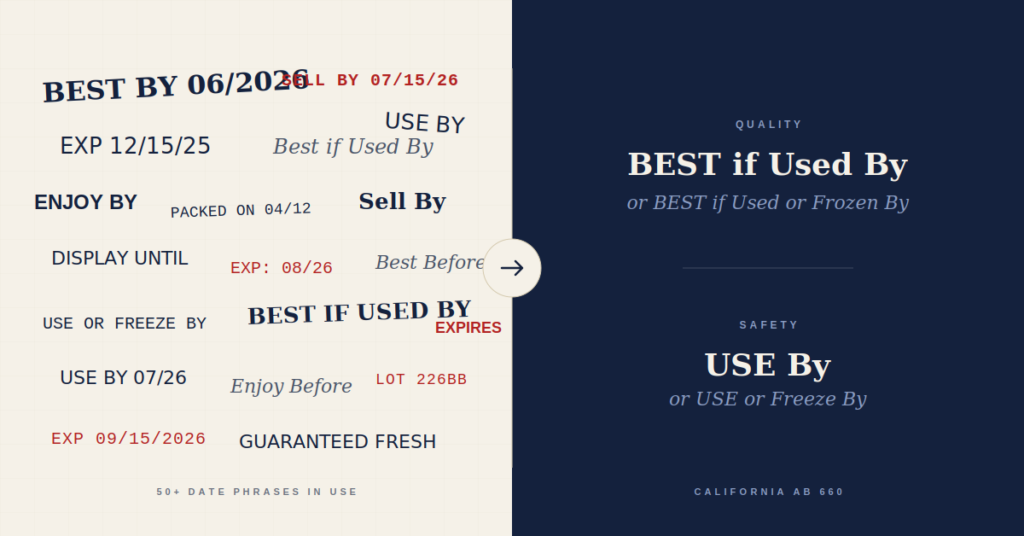
According to the California Department of Food and Agriculture (CDFA), more than 50 different date phrases have historically appeared on U.S. food packaging. AB 660 replaces this patchwork of consumer-facing date phrases on packaged food sold in California with two standardized categories.
- Manufacturers must use “BEST if Used By” or “BEST if Used or Frozen By” to indicate quality, and “USE By” or “USE or Freeze By” to indicate safety.
- Consumer-facing “sell by” dates are prohibited, though retailers can retain coded internal versions for stock rotation – with eggs, infant formula, and beer and malt beverages being exempt.
AB 660 is not an isolated development. The Food Date Labeling Act of 2025 has been reintroduced with bipartisan support to establish a national two-category labeling standard, while the FDA and USDA continue evaluating food date labeling policies. Dozens of food waste initiatives have emerged across individual states over the past 18 months. At the same time, the FDA delayed enforcement of FSMA Section 204’s lot-level traceability requirements for high-risk foods until July 20, 2028.
Modern food production relies on high-speed automated lines where coding & marking systems print expiration dates, lot numbers, and traceability information on thousands of products every hour. Even relatively small labeling changes require software updates, packaging revisions, production validation, quality checks, and coordination across manufacturing facilities. If multiple states adopt different labeling requirements, manufacturers may be forced to maintain separate packaging configurations or redesign production processes to comply with varying regulations, adding complexity, cost, and operational risk.
Coding & marking systems are becoming compliance platforms
For food manufacturers, AB 660 will translate into changes at the production line. Continuous Inkjet (CIJ), Thermal Inkjet (TIJ), Thermal Transfer Overprinters (TTO), and Laser systems from vendors such as Domino, Markem-Imaje, and Videojet print variable content and codes at high throughput and reprogramming those systems for California-specific labeling means software updates, additional quality checks, and in some cases, separate production runs. Thermal label printers complement these production-line technologies, generating case, pallet, and shipping labels that support downstream warehousing, distribution, and retail operations, thereby ensuring labeling consistency throughout the supply chain.
OEMs serving CPG customers are likely to see increased demand for software capable of managing multiple concurrent labeling schemes. Manufacturers will increasingly expect coding systems to support dynamic content management, rapid software updates, and seamless integration with enterprise production and quality systems.
Looking Ahead
California’s AB 660 should be viewed as an early indicator toward greater labeling standardization with a focus on reducing consumer confusion, minimizing food waste, and encouraging consistent data management across the supply chain by simplifying date labels. For national food manufacturers, maintain state-specific packaging is operationally complex and expensive. VDC believes that AB 660 can become a de facto standard as seen with previous California initiatives such as Proposition 65 and recycled content requirements – many large brand owners may choose to adopt AB 660’s labeling conventions across their US product portfolios rather than manage multiple packaging variations.
AB 660 complements, but does not replace, broader packaging-centric digital transformation programs like GS1 Sunrise 2027 and GS1 Digital Link. The regulation does not directly address serialization, recalls, or end-to-end traceability; however, it provides the opportunity for manufacturers to modernize packaging by simplifying label content and making reducing excess text including multiple date formats. As regulatory requirements, sustainability initiatives, and supply chain digitization programs continue to evolve, food manufacturers can now think of labeling as more than a compliance exercise.
Will brand owners simply update their labels to comply with AB 660 OR will they look to redesign their labeling strategy for a future built on standardized data, digital consumer engagement, and end-to-end traceability?
Explore VDC’s latest research on Industrial Coding & Marking Solutions, Serialization & Traceability, and GS1-enabled supply chain transformation to learn how ecosystem participants are preparing for the next generation of labeling and compliance.