The Robotics Market Is Poised for A Major Change – And It Has Nothing to Do With Humanoids
Having just spent two days with all of the major robotics companies at the huge IMTS show in Chicago, it’s clear that AI is about to unleash a major expansion of the robotics market. The ability of AI-enabled robots to accommodate variations in the processes they execute – and not have to be precisely programmed to very tight tolerances for very specific motions – is going to open up robots to a huge range of use cases and customers that were previously locked out by complexity and price. This will have enormous implications for the entire robotics industry, their channel partners, and for a huge and growing universe of robotics customers.
Up until now, manufacturers have had to precisely engineer the environment around a robot so that there is little to no variation in the task it must execute. Parts must be consistently presented. Fixtures must hold them in place. Lighting must be controlled. Products must be separated and oriented. Engineers must anticipate exceptions and program how the system should respond. This work is complex and expensive, which has concentrated industrial robotics in applications where high production volumes justify substantial engineering and setup required to enable a robot for a specific process. The huge number of lower volume manufacturers – manufacturers with significant variability in their processes – as well as smaller, less sophisticated manufacturers, have been effectively shut out of the robotics market since its inception. What robot companies demonstrated and discussed at IMTS made clear that AI will fundamentally change that equation, and that the robotics industry and manufacturing is going to change significantly as a result.
AI’s ability to handle real-world variation will make robotics viable for thousands of applications that have historically been too complex or expensive to automate.
The Economics of Variation
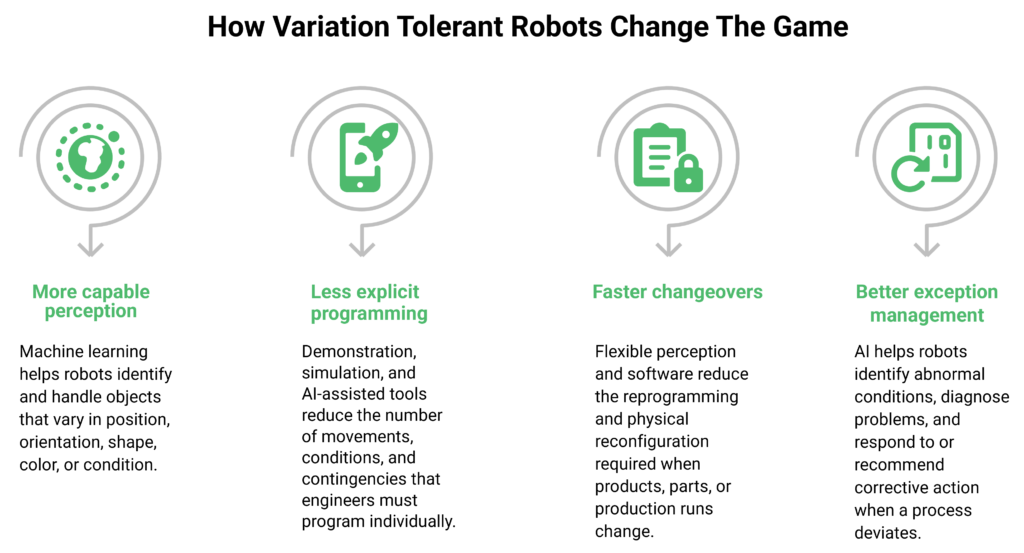
Despite every effort to standardize manufacturing processes, variation is the norm. Parts are not perfectly manufactured or presented one-hundred percent of the time, lighting is not always exactly right, tooling is not always within spec. AI is showing it can adapt to variation in four important ways:
AI-assisted programming will reduce deployment time, engineering expense, and dependence on scarce robotics expertise, bringing automation within reach of smaller manufacturers.
For the hundreds of thousands of small and mid-sized manufacturers whose operations involve high product variation, smaller production runs, and frequent changeovers, these innovations are game changing. Below are three strong examples:
- Food processors and packagers: Meat, baked goods, produce, and other food products naturally vary in size, shape, position, and condition. More capable AI-enabled perception allows robotic picking, sorting, inspection, and packaging without requiring highly standardized products or presentation.
- Contract metal fabricators and job shops: These manufacturers produce a changing mix of parts in relatively small batches. AI-enabled vision, easier programming, and faster changeovers can make robotic machine tending, grinding, and material handling economical without requiring a dedicated cell for every part.
- Automotive and industrial component suppliers: Thousands of smaller suppliers produce diverse components for multiple customers, often with changing designs, volumes, and quality requirements. More adaptable AI-enabled robotic cells can handle broader part families, accelerate changeovers, and help suppliers respond to shifting demand without repeatedly investing in dedicated automation.
These limited examples barely scratch the surface of the wide range of customers and industries where AI-enabled robots that are variation-tolerant are likely to be rapidly adopted in the coming years
Major Robot Companies Are Pursuing This Opportunity
Physical AI and AI-enabled robots were a critical theme at IMTS this year. FANUC, one of the world’s largest robotics companies, has released a ROS 2 driver, added Python support, enabled high speed external control, and integrated its simulation environment with NVIDIA Isaac Sim. These capabilities allow developers to combine FANUC robots with external AI, perception, computing, and simulation technologies more readily.
Yaskawa, a Japanese robotics heavyweight, is pursuing a similar objective through MOTOMAN NEXT. In July 2026, it announced a developmental system combining MOTOMAN NEXT with Google DeepMind’s Gemini Robotics model. Yaskawa says the system can interpret general instructions, plan tasks, and attempt recovery from errors such as dropping an object. The company has not yet announced specific commercial availability, so this should be viewed as evidence of technical direction rather than broad market readiness.
These initiatives clearly indicated that major robot manufacturers are investing in systems that can perceive more, plan more, and operate with less detailed programming, which is sure to resonate with the long tail of small and mid-sized manufacturers who have been unable to take advantage of automation solutions.
High-mix, lower-volume manufacturers represent a major untapped market because AI can overcome the process variation that has historically made automation uneconomical.
Reusable Application Knowledge Will Become Extremely Valuable
As basic programming of robots becomes easier, the ability to produce precise, repeatable robot motion will become less differentiated. The more durable source of value will be the ability to automate a specific process reliably despite the variation found within it. That requires understanding how to weld inconsistent parts, pick irregular food products, inspect complex assets, tend a family of machines, or manage exceptions in a particular warehouse workflow. This knowledge can be embedded in software, perception models, tooling, standardized cells, workflow designs, and operating data. Work that once required a largely custom project can become a more repeatable solution. That shift has important implications for robot manufacturers, machine vision providers, tooling companies, software developers, and integrators. The advantage will shift toward companies that convert application knowledge into repeatable solutions, rather than recreating each deployment from scratch.
Customer specific engineering will remain necessary, though less complex and more repeatable. Robotics applications will continue to require process design, tooling, controls, safety engineering, commissioning, validation, training, and support. But companies that reuse more of what they learn should be able to deploy faster, manage risk more effectively, and serve smaller opportunities profitably.
The Installed Base Creates A Significant Retrofit Opportunity
The International Federation of Robotics counted approximately 4.66 million industrial robots operating worldwide in 2024, including over 400,000 in the United States. Many existing systems will gain additional capabilities through AI-enabled retrofits that include improved vision, sensors, tooling, edge computing, monitoring, or software. Others will be constrained by older controllers, closed interfaces, safety requirements, or upgrade costs that exceed the economic benefit. The retrofit opportunity, while still enormous, is therefore a subset of the installed base: mechanically sound systems whose capabilities can be expanded economically without replacing the complete robotic cell.
Variation Tolerant Robots Are the Future of the Robotics Market
Taken together, these moves point to the same conclusion: AI will make robotics far better at handling real-world variation. As robots learn to adapt when parts differ, objects move, conditions change, or tasks go off plan, automation becomes viable in thousands of applications that have resisted it. That is a new and real growth opportunity that is likely to transform the industry and manufacturing as we know it.