The Long Tail Is Different From The Rest of Your Business
In most industrial and operational tech businesses with recurring revenue, leadership’s attention flows to the top of the customer base. The largest accounts get named owners, quarterly business reviews, custom roadmaps, and executive air cover. That focus is rational, but it leaves a structural blind spot. Beneath the named account threshold sits the long tail: the hundreds or thousands of small customers that, individually, are too small to merit a human relationship, but collectively represent a meaningful share of revenue and an even larger share of churn risk. How well a company manages that tail quietly determines its net revenue retention, which in turn can materially impact growth and profitability. Despite the importance of the long tail, most companies manage it by neglect.
The long tail can have a significant impact on net revenue retention, yet most companies manage it by neglect.
The challenge is that the long tail resists the playbook built for enterprise accounts. You cannot assign a dedicated success manager to a customer paying a few hundred dollars a month without destroying the unit economics. You cannot run a custom onboarding for every account. The instinct, then, is to leave the tail alone and hope it renews. It usually doesn’t, at least not at the rate it could. Small accounts churn silently, expand rarely, and generate support costs that erode their already thin margins. What is changing is the cost of doing better. AI has become a genuinely powerful tool for managing the tail. It can now automate work that previously required human judgment, and therefore could never be justified for a small account: reading early signals of risk, personalizing outreach, and deciding where scarce attention is best spent. The economics that once forced neglect are beginning to shift. The companies that win here are the ones that treat the long tail as a distinct discipline with its own operating model, not as an afterthought to enterprise motions.
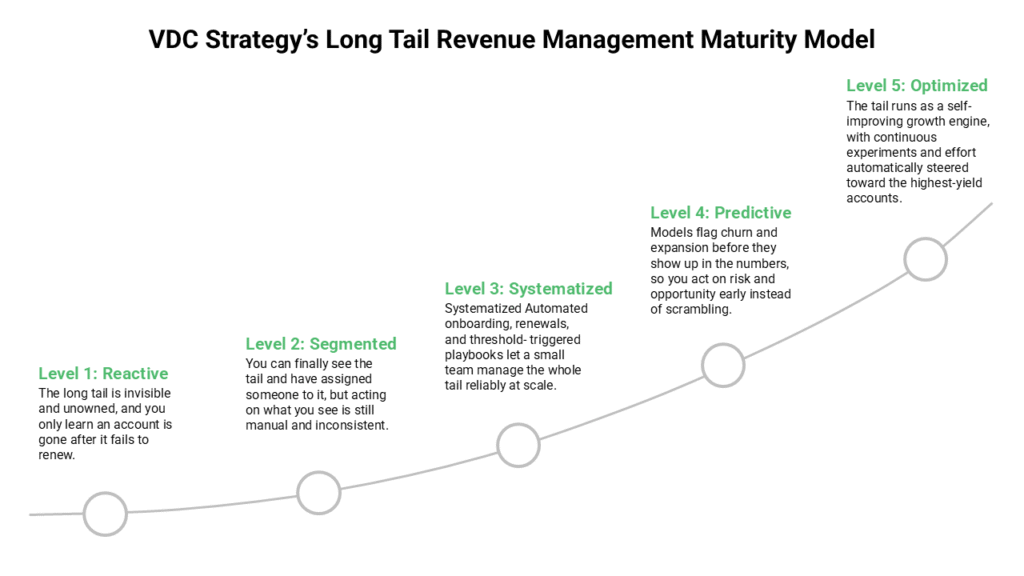
At VDC Strategy, we’ve built a maturity model to give leaders a way to determine where they stand today as managers of their company’s long tail of customers, and to decide what action to take next. The five levels below describe a progression from reactive neglect to continuous, automated optimization. Each level has recognizable symptoms, and advancing from one to the next requires specific investments in data, tooling, and ownership. You can also take a short ten question self-assessment here to determine exactly where your organization stands and what step to take next.
Level 1: Reactive
At the first level, the long tail is effectively invisible. Renewals are processed annually, often by a finance or operations team that treats them as administrative events rather than commercial moments. Churn is discovered only after the fact, when an account simply doesn’t renew and no one knows why. There is no single owner for the segment, no agreed definition of what even constitutes the tail, and no instrumentation to see what these customers are doing. Revenue leaks continuously and quietly. Leaders at this stage frequently overestimate their retention because they are measuring it only on the accounts they actively manage, while the tail erodes beneath the surface. The defining characteristic is the absence of intent: the long tail isn’t managed poorly so much as it isn’t managed at all.
Level 2: Segmented
The move to Level 2 begins with seeing the tail clearly. The company defines the segment, usually by revenue band, account size, or service tier, then sizes it and assigns explicit ownership, even if that owner is a single analyst or a pooled team rather than dedicated headcount. Basic health signals start to get tracked: product usage, login frequency, payment behavior, support ticket volume, and contract dates. For the first time, the organization can answer questions like how much revenue sits in the tail, what its blended churn rate is, and which cohorts are deteriorating. The limitation at this stage is that visibility outpaces action. The data exists, but the response to it remains inconsistent and largely manual. Someone notices a declining account, but whether anything happens depends on whether they have time that week. Insight has arrived; systematic execution has not.
For some industrial and OT companies, getting to Level 2 is genuinely hard, because the signals you need are often trapped on equipment that is offline or held by the channel partner who owns the customer relationship. The health signals here are not logins and seats but telemetry: runtime hours, fault codes, consumables consumption, service history, and warranty status. Getting that data off the asset and into a single view, then reconciling it with what dealers and distributors know, is the real work of Level 2 for a physical-product company.
AI now automates valuable retention work that once required a person, making it economical to serve accounts that never justified human attention.
Level 3: Systematized
Level 3 is where the economics finally work. Digitally led motions replace human touch at scale, allowing the company to serve thousands of small accounts efficiently and consistently. Onboarding becomes automated and self service, with guidance built into the product that drives customers to first value without a human in the loop. Renewal workflows fire automatically: reminder sequences, payment retries, and upgrade prompts triggered by usage milestones. Crucially, the organization builds playbooks that activate on defined risk thresholds. A usage drop of a certain magnitude triggers a reengagement campaign, a support escalation pattern triggers a proactive outreach, and an approaching renewal with weak engagement triggers a save motion. Increasingly, AI is what makes these motions more than blunt automation: it can interpret the messy signals specific to each account that rigid rules miss, draft outreach tailored to the individual customer, and route each account to the right play. The effect is to give a small, leveraged team something closer to the judgment of a dedicated owner, applied across thousands of accounts at once. The work shifts from reacting to individual accounts to designing and tuning the systems that handle them in aggregate. A small team can now influence the trajectory of the entire tail, and retention improves not through heroics but through reliable, repeatable process.
Level 4: Predictive
At Level 4, management becomes anticipatory rather than responsive. The company builds models that score every account for churn and expansion propensity, drawing on behavioral, financial, and engagement signals, so that risk and opportunity become visible before they surface in the numbers. Rather than waiting for a usage cliff or a missed renewal, the system flags an account weeks ahead and routes it into the right motion. Playbooks are no longer triggered only by simple thresholds but selected by predicted cause and likely outcome, so the response fits the situation rather than applying one template to every case. The organization stops managing the tail through the rear window and starts managing it through the windshield, catching problems while there is still time to change them and surfacing expansion the moment an account is ready for it. The signals that earlier levels could only see in hindsight now arrive early enough to act on.
Industrial and OT companies have a natural advantage here, because many already run predictive maintenance, using sensor data to forecast equipment failure before it happens. The same discipline, and often the same data, can be aimed at the commercial relationship: predicting which service contracts will lapse, which consumables orders are about to stop, and which customers are ready to move to a higher tier. A company that can predict a bearing failure can predict a churn risk. It simply has not yet pointed the model at revenue.
Level 5: Optimized
At the highest level, the tail becomes a continuously optimized growth engine. Prediction is now table stakes; what distinguishes a Level 5 company is what it does with the foresight. The organization runs continuous experiments on the levers that move the segment, including pricing, packaging, messaging cadence, and nudges built into the product, and treats the tail as a living portfolio to be tuned rather than a book to be maintained. Effort is automatically reallocated toward the accounts with the highest expected yield, whether that means a save worth protecting or an expansion worth pursuing, and every intervention is measured by its return so the playbook compounds over time. The long tail stops being a cost center to be contained and becomes a deliberate, measurable source of growth, with the operating model improving itself as more outcomes accumulate.
Where Most Companies Stand
In practice, most organizations cluster at Levels 1 and 2. They have either no visibility into the tail or visibility without the operating model to act on it. This leaves substantial retention and expansion value stranded, and that value compounds, because every point of net revenue retention multiplies across the entire book year after year. Advancing a single level typically lifts net revenue retention by several points, and for a company with a large base of small accounts, that improvement often delivers a better return than the same effort spent chasing new logos. New customer acquisition is expensive and competitive; the long tail is already inside the building, already paying, and disproportionately responsive to relatively modest operational investment. That calculus is only improving, because AI is steadily lowering the cost and the skill barrier to operating at the higher levels, putting capabilities that once required large data science teams within reach of a lean operation. This makes the value stranded at Levels 1 and 2 more capturable now than it has ever been.
The strategic implication is straightforward. Leaders should locate themselves honestly on this curve, resist the temptation to skip levels, and sequence their investments deliberately, putting visibility before systems, systems before prediction, and prediction before optimization. The long tail rewards companies that treat it as a discipline. For those still managing it by neglect, the gap between where they are and where they could be is one of the largest and most overlooked sources of durable growth available to them.
Put visibility before systems, systems before prediction, and prediction before optimization; the tail punishes companies that skip levels.
What This Means for Industrial and OT
Take our diagnostic to find out where your company actually stands, because the honest answer is usually further back than it feels. Most leaders assume they are more mature than the evidence supports, and that gap between perception and reality is precisely what lets value leak away unnoticed. In ten questions, the assessment places you on the five-stage curve and, just as usefully, exposes the single dimension holding you back, whether that is ownership, visibility, automation, prediction, or experimentation.
Once you know your level and your weakest link, you can sequence your investment deliberately, building the next capability the model calls for rather than buying tools your operating model is not yet ready to use. A few minutes of self-assessment, shared and debated with your team, will tell you not just what level you are at but where the single highest-value action sits right now. If small customers add up to real money for you, this is the difference between slowly getting better and standing still while that money quietly slips away.