AI Was Everywhere at GSX 2026
Artificial intelligence was a big part of the story at GSX 2026. Nearly every one of the show’s countless security tech exhibitors seemed to be promising AI-powered analytics, autonomous patrols, or an intelligent perimeter. AI occupied much of the conversation from the show floor to the evening receptions.
We took advantage of our time there to conduct some real-time attendee research into where AI is taking physical security. And the results were more than a little surprising. We want to caution that at 84 respondents, the sample size is smaller than a full blow industry landscape survey, which would typically include several hundred respondents, and that it includes groups with differing motivations – professionals from security product vendors who are pushing AI, as well as security practitioners, integrators and consultants who are trying to absorb the onslaught of AI product claims. Nevertheless, we believe the insights are directionally correct and merit careful consideration by the physical security vendor community given the strong physical security expertise and knowledge of the respondents.
Most security leaders at GSX believe AI’s near-term promise is overstated. They expect real change to arrive gradually over the coming decade.
Skeptical on the Near Term AI Hype, Bullish on the Decade
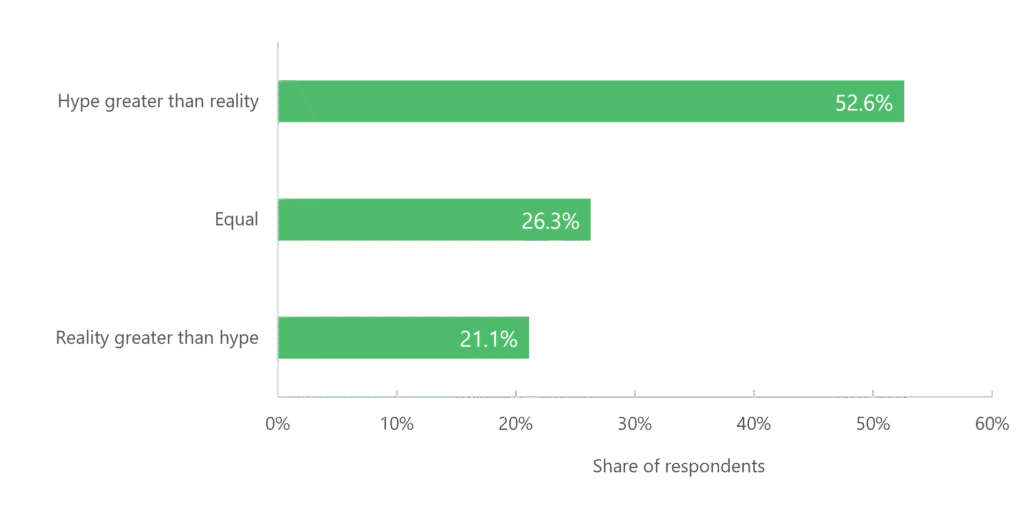
We began by asking respondents their view on AI hype versus reality over the next five years. More than half of respondents (52.6%) said the hype around AI’s ability to transform physical security over the next five years exceeds the reality. Only about one in five (21.1%) believe reality will outrun the hype. The remaining 26.3% see the two as roughly balanced. Of note, many who believe that the reality is greater than the hype were passionate that very few people – inside and outside of physical security – fully appreciate the true power of AI, and that it will transform security (and the world overall) in ways that no one truly understands.
Yet that near-term skepticism sits beside a surprisingly aggressive view of what AI will do to the security workforce over ten years.
Asked where AI will have its biggest impact over the next decade, respondents pointed first to labor. Reduced labor led at 41.7%. A third (33.3%) said labor and incident reduction will matter equally, and only a quarter (25%) picked fewer incidents as the primary benefit.
AI’s 5 Year Impact on Physical Security: Hype vs. Reality?
AI’s Biggest Security Impact, 10 Years
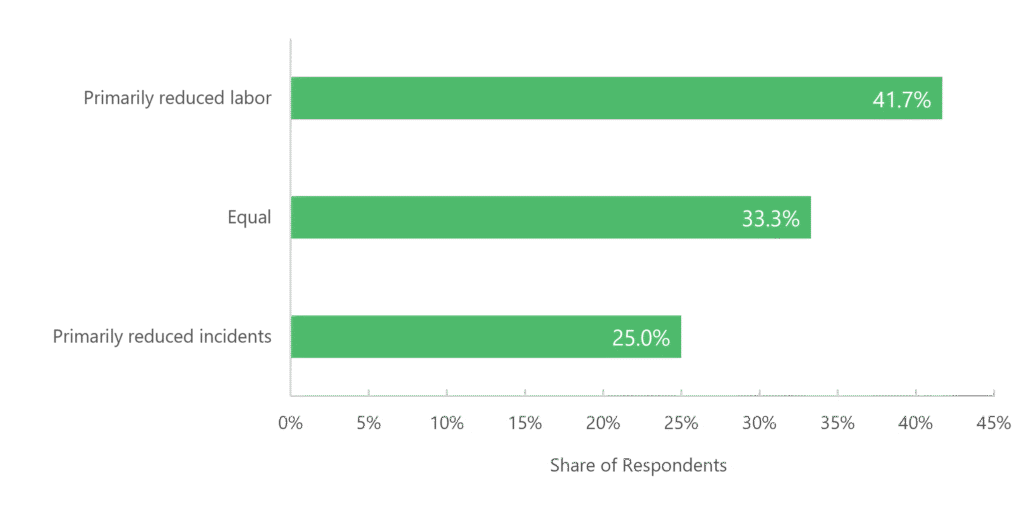
That tilt is important because these are two very different buying conversations. A labor-reduction pitch resonates with a CFO and a facilities budget. An incident-reduction pitch is better for a CSO, a risk committee, and an insurer. Three-quarters of respondents see labor savings as at least an equal benefit, yet much of the industry still leads with detection accuracy and incident prevention. Vendors that cannot put a number on the guard hours or monitoring costs they remove are likely pitching to a minority of the market.
Incident reduction has not lost its place, though. Nearly 60% of respondents rank it at least on par with labor savings. The strongest story pairs the two: a hard labor number, reinforced by a credible risk benefit.
Guard Replacement Expectations Are High
This was the most striking result. Among our respondents, a third (33.4%) expect AI-enabled capabilities to replace 40% or more of security guards within ten years, split evenly between the 40–60% and 60–80% ranges. Another 23.3% expect 20–40% replacement, the single most common answer.
At the other end, about 43% expect replacement below 20%, and just 6.7% expect no impact at all. Put differently, more than nine in ten attendees expect AI to take some share of guard labor, and a majority expect it to take at least a fifth within ten years.
% of Guards Replaced by AI in 10 Years
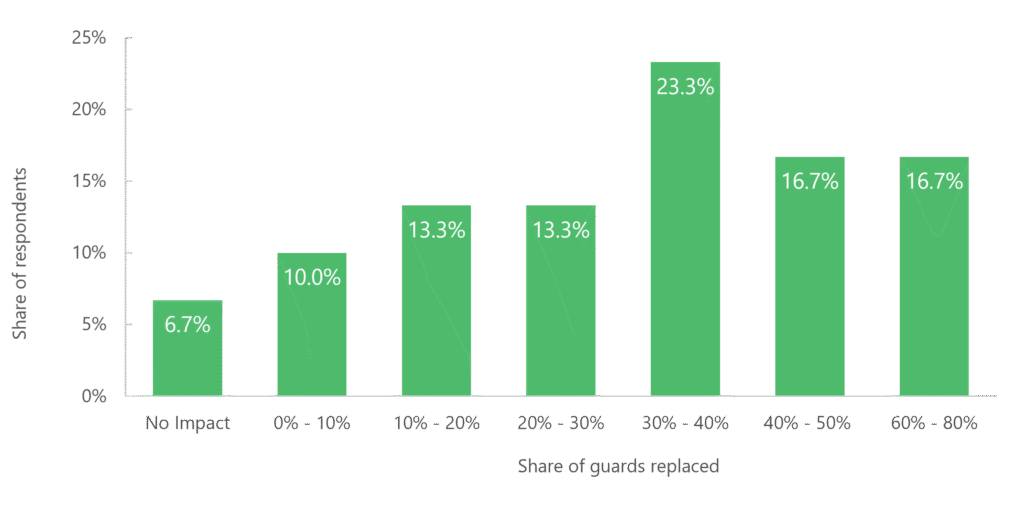
Set that beside the hype question and a clear pattern emerges. Attendees doubt AI will transform security in five years, but they expect it to reshape the workforce in ten. The skepticism is about timing and today’s product claims, not about direction.
Robots with Authority to Use Force Are Unpopular, but Perhaps Inevitable
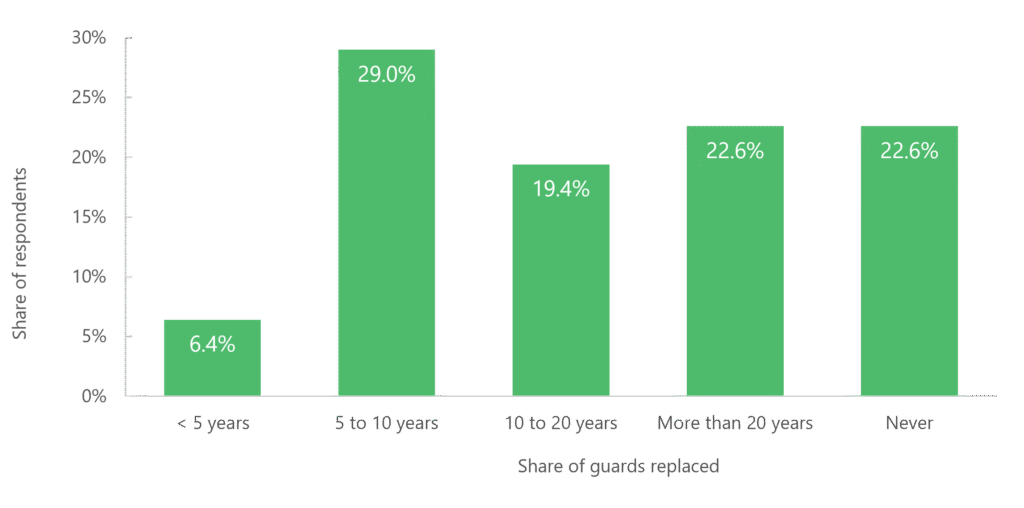
Our question about how long it will be before robots are authorized to use force in civilian applications was highly provocative and engendered strong reactions. Nobody we spoke with liked the idea of a robot using force. The disagreement was about whether it can be stopped. Nearly a quarter (22.6%) said it will never happen, and for many of them “never” was less a forecast than a hope: a line they want the industry to hold permanently. 22.6% put it more than twenty years out. Only 6.4% said within five years. The largest group (29%) said five to ten years, and 19.4% said ten to twenty.
Most see autonomous robotic use of force as inevitable, whether they welcome it or not. More than half (54.8%) expect robots to be authorized to use force within twenty years, and more than a third (35.4%) within ten. Autonomous detection and response are already accepted as the future.
Practitioners expect AI to replace a meaningful share of security guards within a decade. Guard-heavy business models should start planning their technology transition now.
How Long Until Robots May Use Force?
What It Means for Vendors and Investors
Security leaders are deeply uncomfortable with robots using force, and many hope it never happens. That said, many think it’s inevitable.
Proof beats promise. With most buyers discounting near-term claims, the vendors that win will be the ones who quantify outcomes. That means documented reductions in guard hours, false alarms, or incident response times, drawn from real deployments. Vague “AI-powered” positioning falls flat because it signals exactly the hype buyers told us they distrust.
Sell both value stories, to both buyers. The even split between labor and incident reduction argues for a dual value proposition. Pricing and packaging should reflect it: a labor-offset model for operations and finance, and a risk-reduction model for security leadership. Companies that price only on devices or seats leave the larger, outcome-based value uncaptured.
The guard market hangs in the balance. If a third of practitioners are right that 40% or more of guard roles will shift to technology within a decade, a large pool of labor spend moves into software, sensors, and remote monitoring. For security technology vendors and private equity sponsors, that makes AI-enabled monitoring, video analytics, and tech-augmented guarding platforms attractive.
Respect the line on force. Buyers are clearly hesitant around autonomous force. Roadmaps that keep a human in the loop for enforcement decisions will face less resistance and less regulatory exposure than those that do not.
The Bottom Line
GSX attendees are not anti-AI. They are anti-hype. They expect meaningful change to how security is staffed and delivered over the next decade, but they want evidence, clear economics, and firm boundaries along the way.
For security technology companies and the investors behind them, the message is straightforward. Build value propositions around measurable labor and risk outcomes, price to that value, and keep humans in control of the decisions buyers are not ready to hand over.