Doing Something vs. Doing Something Smart
If your fund holds industrial technology or operational technology companies, you have probably already had the conversation. Maybe you even started it. The board meeting where someone asks the CEO how the company is integrating AI into its products. The value creation conversation that focuses on the AI initiatives. The exit narrative that needs an AI element because every buyer will ask. The pressure for PE investors to push their companies on AI adoption is intense and real.
But here is the uncomfortable truth, and the reason we wrote this article. We have watched this pressure play out inside industrial and OT companies, and too often the board’s intensity has driven management to make poor decisions about AI in the interest of doing something, without doing anything smart. Forcing an AI strategy that way produces highly unfavorable outcomes. The company spends real money, engineering drifts away from the roadmap, customers ignore ill-conceived features that were rushed into production, and the buyer’s diligence team sees through the story.
To provide investors and their industrial and operational technology portfolio company leaders with more disciplined guidance in their pursuit of their AI product strategies, we have developed a five layer framework for pressure testing an AI strategy:
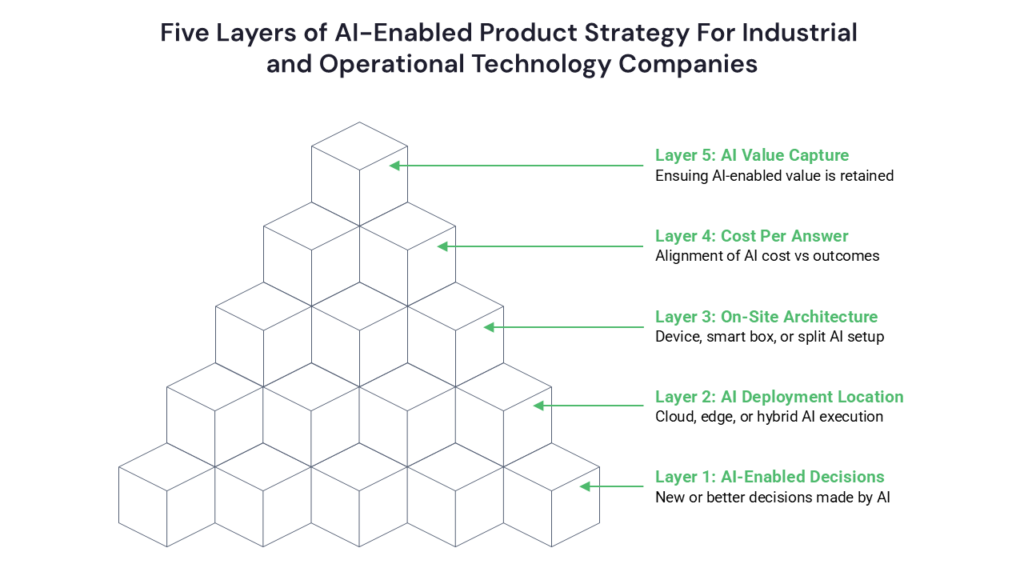
Layer 1: What customer decisions or actions should be AI-enabled?
Traditional industrial and OT products sense, measure, and report, and a person decides what to do. AI-enabled products go further and make decisions or take actions for the customer. That difference matters. Decisions and actions the customer no longer has to handle are worth paying for. So the first question is which decisions and actions to hand over, and the good ones share certain characteristics.
It must be a new or better decision or action. Start where the value starts: what specifically is the AI deciding or doing? It must be something new or better than what came before, done faster, more consistently, or at a scale no person or conventional system could match. If the AI is simply repackaging what a person already handles just as well, the customer is being asked to pay for a change they cannot feel.
How often does it come up? The best candidates are decisions and actions that recur constantly, thousands of times a day rather than a few times a year. Volume is the engine: every call the AI makes teaches it something and hands the company another data point proving the product earns its keep.
Can anyone tell whether the AI got it right? The best candidates get checked quickly, in minutes rather than months. Fast feedback is what turns volume into improvement, and a decision or action that cannot be checked cannot be improved or sold with proof.
When the AI is wrong, does something catch the mistake? Handing decisions and actions to a machine only works if the failure path is designed as carefully as the success path. The strongest designs answer this question yes twice. When the AI is unsure, it hands the call to a human. And it is added to the checks the customer already runs, not swapped in for them. This is why edge AI can work even in industries where a single mistake is a disaster. In the near term, no one is betting that the AI is perfect. The bet is that the AI plus the old checks catch more than the old checks alone, and that is an easy bet to win.
Does it improve a number the customer already tracks? This question predicts commercial traction better than any other factor. Downtime, scrap, guard hours, service truck visits: if the AI’s decisions and actions move a number the customer already reports to their boss, the sales cycle is shorter and the case studies write themselves.
Layer 2: Where does the AI need to run?
With the customer decisions or actions to be handled by AI well-defined…
What points to the cloud? The cloud is the easiest place to build, improve, and watch an AI. Models can be as large as the problem demands, updates reach every customer at once, and engineers can see exactly how the AI is behaving. Decisions that can wait a moment, that draw on data from many sites, that raise no privacy or security concerns, or that keep changing shape as the business learns tend to belong here.
What points to the edge? Five conditions pull the work in the other direction, out of the cloud and onto the site itself.
- Speed. Some decisions must happen in a few thousandths of a second. A camera rejecting a bad part on a production line, a mobile robot avoiding a collision, a robotic arm picking parts off a moving conveyor. No round trip to a distant data center is fast enough.
- The cost of moving data. Video, vibration readings, and sensors that sample thousands of times per second are too heavy to send upstream. The device on site boils an ocean of raw data down to a short list of events worth reporting.
- Working without a connection. Some equipment must keep running when the network drops. Remote wells, ships, mines, and military systems all live here.
- Privacy and control. Some customers will not let their data leave the building, and in some industries the law forbids it. This is common in utilities, hospitals, and defense, and it is spreading everywhere else.
- Cloud bills. When thousands of devices each pay a cloud provider for every question the AI answers, at some point a capable chip in the device is cheaper.
The hybrid middle ground. In practice, most successful AI products combine the two: the AI learns in the cloud and works on the device. Data from the fleet flows up, the AI improves centrally, and better versions push down to every device automatically.
A final word of caution: if privacy was the condition that forced AI to the edge, things get harder both technically and commercially. The company must send up samples rather than everything, strip out what customers consider sensitive, and secure the rights in its contracts.
Layer 3: What is the architecture on-site?
The last layer addressed whether the intelligence belongs on site at all. This layer considers what the setup looks like once it is there. There are three basic choices, and each carries different costs and different economics for the business.
On the device itself. The AI can sit directly on the sensor, camera, or controller. This is the answer when speed matters most or the connection cannot be trusted. The cost shows up in gross margin: a more expensive device, tight limits on heat and power, and refresh cycles that now carry an AI dependency.
One smart box per site. A single computer on site can serve many simple sensors. This is the answer when the site needs more computing power than a single sensor allows but the data cannot leave the building. It often has the best cost structure, because one CPU does the thinking for dozens of cheap sensors.
Split the work with the cloud. The company can teach the AI in the cloud and run it on the device. This is the most common pattern and usually the right one. Data from the fleet flows up, the AI improves centrally, and better versions push down to every device automatically.
Layer 4: What does every answer cost?
Traditional software has a wonderful property: once built, each additional use costs almost nothing. AI breaks that rule, and failure to acknowledge this results in products whose cost could exceed their value, and whose margin declines as they become more heavily used by customers.
Every answer has a price. When the product calls an AI model in the cloud, the provider meters the work in tokens and bills for every one. When the model runs on the device instead, the meter changes form but does not disappear: it becomes chip cost, power, and heat. Either way, every decision the AI makes costs real money, and across a fleet of thousands of devices making thousands of calls a day, fractions of a cent can add up.
Know the cost per decision. The number that matters is what one decision costs to make versus what it is worth to the customer. A product priced at a flat fee while its costs are metered by usage has margins that erode as adoption grows.
Spend tokens like inventory. Use the smallest model that does the job. Handle routine calls on the device and send only the hard cases to a big model in the cloud. Cache answers to questions that repeat themselves and track cost per decision the way a manufacturer tracks cost per unit.
Layer 5: How does the company win and get paid?
The final layer determines the economics of the AI strategy. An AI-enabled product creates value for its owners when the company keeps a meaningful share of the benefit it creates, rather than passing it all to customers who realize it in their operations, chip vendors who capture it in their hardware, or competitors who copy the feature and initiate a price war. The companies that keep the greatest share of their AI value will do it through a handful of disciplined choices.
The data advantage. Start with a question that belongs in every diligence checklist: does the company have access to data its competitors cannot get? Examples include contracts granting rights to machine data, a large installed base already reporting home, years of labeled failure records. If no, the AI is a feature any competitor can copy with the same chips and the same public models, and the market will price it accordingly. If yes, a flywheel starts turning. More devices produce better AI, better AI makes a better product, and a better product sells more devices.
The hidden cost. Budget honestly for the unglamorous part. Building the first version of the AI is twenty percent of the work. Rolling it out across thousands of devices, watching for accuracy to slip, retraining, and keeping versions straight across hardware generations is the other eighty percent, and it never ends.
How the company gets paid. This choice shapes everything else, and there are three options. Give the AI away to defend share. Charge for it as a premium tier. Or tie revenue to the result: uptime, catch rate, throughput. The third choice – tying pricing to outcomes – is the one that has the most potential to move valuations, because recurring revenue tied to outcomes carries a hardware company toward a software multiple. But it demands honesty about risk. When the company charges for results it will deliver, it owns the results, including the ones caused by the customer’s dirty sensors and deferred maintenance. Companies that make this work define the outcome (and the prior state) precisely in the contract and spell out what the customer must do to keep the guarantee valid. Outcomes based pricing is non-trivial, but it is an emerging holy grail in AI-enabled industrial and operational tech.