How and Why Recurring Revenue Misleads
Recurring revenue is among the most trusted signals of business health, and among the most easily misread. A book of contracted ARR with a high renewal rate is often seen as a powerful indicator of a business that is performing well. Yet these metrics often reveal something quite different, namely the durability of decisions made years ago under conditions that may no longer exist. In many cases the buyer has moved on, the competitive landscape has shifted, and the contract persists through inertia, switching costs, or procurement fatigue. The result is a portfolio that appears stable but contains unpriced risk: revenue whose underlying conviction has decayed even as the cash flow remains intact. Distinguishing earned revenue from inherited revenue is the first place the reported health of a business tends to diverge from its actual position.
Why Industrial and Operational Technology Magnifies the Problem
This gap between appearance and reality is wider, more consequential, and harder to close in industrial and operational technology than many other business. The reasons trace directly to unique characteristics of many industrial and operational technology businesses.
A book of recurring revenue can be unpriced risk in disguise: revenue that continues long after the conviction behind it has quietly decayed.
- Deployment cycles are long. Rolling out shelf monitoring across two thousand stores, instrumenting a fleet, or deploying field sensors across regions are capital commitments made in distinct windows, often years apart. The recurring revenue flows long after the conditions that justified the decision have changed.
- Switching costs are structurally higher. Operational technology is woven into compliance workflows, integrated with operational systems, and tied to physical infrastructure. This is valuable when the product is performing and dangerous when it is not, because it allows underperforming relationships to persist far past the point at which they would have ended in a less embedded category.
- The buyer is often gone. With decisions made on five to seven year horizons, the original sponsor has frequently moved on, leaving the relationship to run through people who inherited it. The qualitative signals that normally indicate account health, namely sponsor engagement and strategic alignment, are weaker and harder to read.
- Competitive consequences are delayed. A vendor can lose the right to win the next deployment cycle years before that loss shows up in the financials, because the existing installed base continues to produce recurring revenue throughout. The customer list looks intact. The forward franchise is already eroding.
The standard diagnostic toolkit, namely gross and net retention, logo concentration, and average contract length, was calibrated for businesses with faster cycles and lower switching costs. Applied here, it describes the surface while leaving the substance underneath largely unmeasured.
The Customer List as the Best Available Lens
The customer list can be a uniquely valuable tool for gaining insight into business health in a recurring revenue business. When analyzed correctly, it reveals which decisions were made when, which relationships are advancing, which are merely persisting, and where the business is genuinely being built versus where it is in decline.
At VDC Strategy, we’ve found that the same customer list can be enlisted to tell a story of exceptional durability or hidden fragility depending on how deeply it is analyzed. Extracting the real insights during diligence requires a specific set of questions, and a willingness from both sides – buyer and seller – to engage with them honestly. That said, for management teams, a deep understanding of the customer list shouldn’t begin when a process starts. It should be part of how the business is run.
The same customer list can tell a story of exceptional durability or hidden fragility, depending entirely on how deeply you are willing to look.
Thinking Critically About Retention Driver A Customer List Is a Lagging Indicator
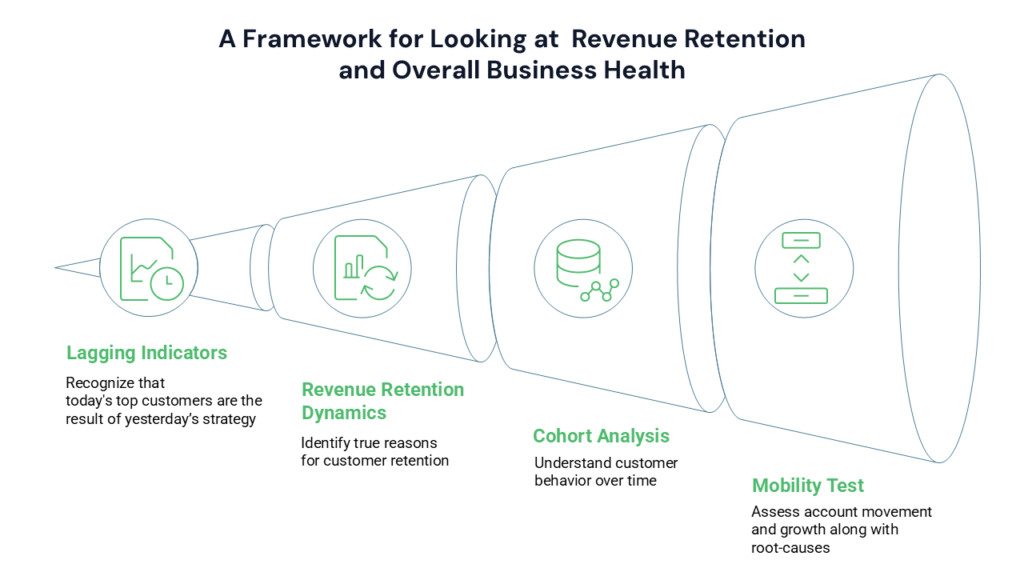
In industrial and operational technology, the customer list is not a picture of the present. It is an artifact of the past, preserved by the very characteristics that make the recurring revenue attractive. The top accounts reflect deployment decisions made three, five, or seven years ago, under a different competitive set and often with a different executive sponsor. Treating that installed base as validation of current positioning is a consequential mistake. The contract is evidence of past conviction, not present competitiveness.
A more productive question for both sides: if new sales stopped today, what would this business look like in four years? Management teams that can answer with specificity, by mapping the maturity of their installed base and the timing of expansion cycles, have a much better understanding of their own trajectory than those that just focus on renewals and retention at a macro level.
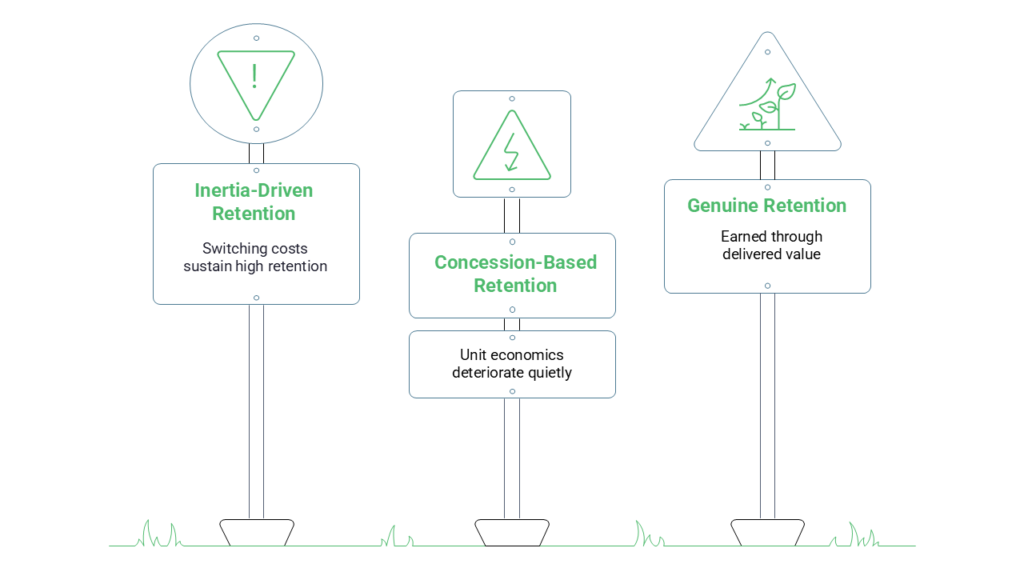
Three distinct drivers of retention can produce similar retention figures, with very different implications.
- Retention by inertia is revenue that persists because leaving is harder than staying, not because the product is still winning on its merits. Vendors can sustain high gross retention for years on switching costs alone, even as product investment slows and competitive alternatives improve, leaving the business exposed whenever a competitor decides to absorb migration costs on the customer’s behalf.
- Retention through concessions is revenue preserved by giving something back to the customer at renewal, whether price, scope, or terms. It holds at-risk accounts via price reductions, stripped down tiers, or expanded scope without corresponding price increases. Unit economics deteriorate quietly, a pattern that only surfaces when you track discount rates across the renewal book or compare contracted value at initial sale against what the same customers pay years later.
- Genuine retention is revenue the vendor is actively re-earning, because the customer is achieving outcomes that make continued use the obvious choice. Earned through delivered value, it builds on itself. It shows up in expansion revenue, internal advocacy, and uncomplicated renewal conversations.
Most analyses treat the customer list as a snapshot. Cohort analysis turns the analysis into a movie, showing which accounts are advancing and which are merely persisting over time.
The Benefit of Cohort Analysis
At VDC Strategy, cohort analysis is one of the diligence techniques we lean on most heavily, because in industrial and operational technology it is often the only way to separate the story a customer base is telling from the story management is telling about it. Aggregate metrics are easy to assemble and easy to defend. Cohort data is harder to manipulate, and considerably more honest about where a business is actually going.
Not All Retention Is Created Equal
The insight that matters most is not whether customers are staying, but why. A business retaining customers through delivered value is in a fundamentally different competitive posture compared to one sustained by switching costs or concessions. The embedded nature of operational technology means the erosion can run for years before becoming visible.
Cohort analysis groups customers by the period in which they were acquired and tracks how each group behaves over time, rather than blending all customers into a single aggregate. Two businesses with identical headline retention can be moving in opposite directions, and only cohort analysis reveals which. This matters more in industrial and
operational technology than almost anywhere else, because long deployment cycles mean a customer base accumulated across seven years contains accounts that bought a different product, in a different competitive environment, from a different version of the company.
Two companies can show identical top-account concentration and face entirely different competitive situations: one with deep, multi-site relationships actively expanding, the other with legacy single-site installations quietly evaluating alternatives. Cohort behavior isolates what aggregate metrics hide. Are recent cohorts expanding to additional locations within a predictable window? Are module attachment rates improving? Or are newer accounts plateauing while legacy accounts carry the growth, a pattern that signals a current product no longer producing the depth of adoption its historical product did?
The Account Mobility Test
The account mobility test is the natural companion to cohort analysis. Cohort analysis tells you how groups of customers are maturing. Account mobility tells you how the relationships at the top of the list are changing year over year, which is often where the gap between a business that is genuinely advancing and one that is quietly coasting becomes most visible.
The movement of accounts within the top customer list over time surfaces the question that recurring revenue and embedded deployment together obscure: is the relationship advancing, or merely persisting?
A healthy business shows existing accounts rising as deployments deepen, alongside newer accounts entering the list and climbing. A list where accounts are earning their position is fundamentally different from one where they are simply holding it. A top customer list largely static for three or more years often reflects an installed base that is neither growing nor at immediate risk of leaving, the precise condition that long cycles, high switching costs, and recurring revenue are collectively best at sustaining and worst at signaling.
Mapping the expansion trajectory of top accounts over three years tells you more about the forward outlook than almost any other analysis, because it cuts through every dynamic that disguises an industrial or operational technology business’s true position.
What Both Sides Are Actually Looking For
Industrial and operational technology rewards durability, but it disguises the difference between durability renewed by current performance and durability inherited from past performance more effectively than almost any other corner of technology. Long deployment cycles, deeply embedded products, and large recurring revenue bases collectively preserve the appearance of strength long after the underlying conviction has faded, which is why diagnosing the difference matters so much here.
For investors, the honest question is whether the installed base reflects a business winning the next generation of deployments, or one living on the durability of past decisions while newer competitors build the relationships that will define the next capital cycle. For management teams, the question is whether you can demonstrate not just the strength of the current base, but the mechanism that produced it: the expansion patterns, the attachment rates, the cohort trajectories, and the depth of integration that makes accounts genuinely difficult to displace for reasons that build on themselves rather than reasons that erode.