Engineering vs. Commerce – A Uniquely Hard And Critical Challenge in Industrial and Operational Tech
Industrial and operational technology companies face a uniquely difficult challenge in managing many aspects of their business, and culture is no exception. On the one hand, they must satisfy the rigorous expectations of technical customers who depend on their products to keep critical systems running. On the other they must simultaneously respond to the commercial pressures of a competitive environment and the realities of business, where sales and margin are paramount. Unlike software-only businesses, where products can be updated instantly and failures are rarely catastrophic, industrial and operational technology companies operate in physical and hybrid environments where reliability is non-negotiable and the cost of getting it wrong can be significant. That dynamic creates a distinctive cultural tension: the organization must be disciplined enough to build products that hold up in demanding real-world conditions, yet agile enough to bring those products to market before the window closes. How a company navigates that tension, and whether it even recognizes it, is enormously important: what gets built, how quickly it gets to market, how customers experience it, and ultimately whether the business grows or stalls.
Industrial tech products must hold up for years in demanding conditions, yet reach the market before the window closes. How a company navigates that tension often determines whether it grows or stalls.
The Engineering-Led Extreme
On one end of the spectrum sits the engineering-led company. These organizations take pride in building things the “right way.” Products are robust, thoughtfully architected, and often admired for their technical integrity. There is a deep respect for reliability, which makes sense. After all, in operational environments, failure isn’t just inconvenient; it can be costly or even dangerous. But when this mindset dominates too strongly, it begins to show cracks. Products take too long to ship. Teams chase perfection long past the point of diminishing returns. Sales teams feel constrained, and opportunities slip away because the organization isn’t willing to move before everything is fully polished. The business becomes excellent at building things, but less effective at building the right things at the right time.
The Commercially Driven Extreme
At the other extreme is the commercially driven organization. Here, the energy is different. The company moves quickly, responds aggressively to customer demands, and is highly attuned to revenue. Deals drive momentum. The organization feels alive, responsive, and outward-facing. But when this orientation goes too far, it creates a different kind of fragility. Promises outpace reality. Engineering teams are forced into reactive mode, constantly trying to keep up with commitments that were made without them. Technical debt accumulates. Over time, the product becomes less stable, and trust, both internally and with customers, begins to erode. The company becomes good at selling, but increasingly strained in delivering.
Culture By Default
Most organizations don’t consciously choose one of these extremes. Instead, the culture develops by default, often based upon the personalities and skillsets of the founders. And because each extreme has strong internal logic, the imbalance often goes unchallenged. Engineers can always justify waiting for a better solution. Sales teams can always justify chasing the next opportunity. Without a deliberate lens, leadership teams can miss the fact that the organization has tilted too far in one direction or the other.
How to Read Your Organization
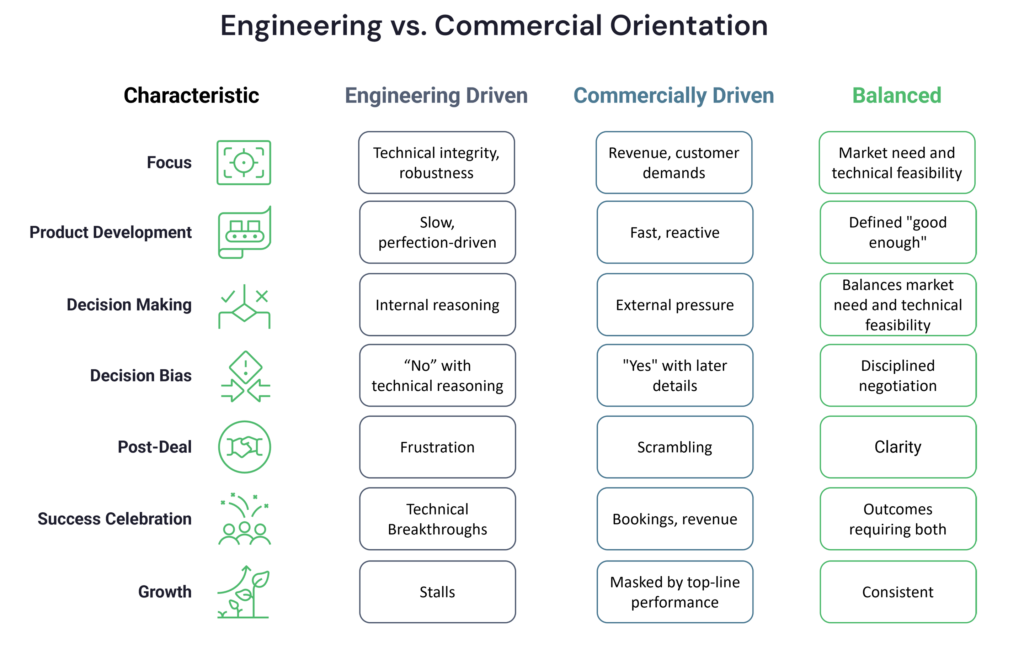
A useful starting point for evaluating where your company sits is to look at how decisions are made. In engineering-heavy cultures, decisions tend to be driven by internal reasoning, what is scalable, what is elegant, what aligns with the architecture. In commercially heavy cultures, decisions are often driven by external pressure, what a customer wants right now, what will close a deal this quarter. Neither is inherently wrong, but the question is whether one consistently overrides the other.
Another revealing signal is how the organization handles tension. What happens when a salesperson asks for something that engineering believes is not ready? In one culture, the answer is almost always “no,” often backed by valid technical reasoning but lacking flexibility. In the other, the answer is almost always “yes,” with the assumption that the details can be figured out later. In a healthy organization, neither reflex dominates. Instead, there is a disciplined negotiation, one that produces clear trade-offs, alternatives, and shared accountability.
Most companies don’t choose to lean
engineering-heavy or commercially-heavy. The culture forms by default, and the imbalance goes unchallenged because each side’s logic feels self-evidently correct.
You can also learn a lot by observing what happens after a deal is closed. In an engineering-driven company, you’ll often hear frustration: “Why did we sell that? That’s not what the product does.” In a commercially driven one, you’ll see engineering scrambling to deliver something that was loosely defined or overly optimistic. In a balanced organization, those moments are rare, not because everything is perfect, but because alignment happened earlier in the process.
Even the way success is celebrated offers clues. If recognition consistently goes to technical breakthroughs, elegant solutions, and system performance, you’re likely skewed toward engineering. If it centers almost entirely on bookings, revenue, and closed deals, the commercial side is dominant. The healthiest companies celebrate outcomes that require both: products that are not only built well, but adopted, valued, and delivered successfully.
The strongest companies don’t treat engineering and commercial goals as a
trade-off. They build mechanisms that force the two sides to integrate rather than negotiate against
each other.
What We See in Practice
From our work at VDC Strategy, this imbalance shows up in patterns that are surprisingly consistent across companies of different sizes and markets. Engineering-heavy organizations often don’t realize how far they’ve drifted until growth stalls. They’ll point to strong products and satisfied existing customers, but struggle to explain why new customer acquisition is slower than expected. In many cases, the issue isn’t product quality; it’s that the organization hasn’t translated its technical strengths into clear, market-facing value. The voice of the customer is present, but filtered or delayed.
Conversely, in commercially driven organizations, the early signals are often masked by strong top-line performance. Revenue grows, pipelines look healthy, and the business feels dynamic. But beneath the surface, we consistently see rising delivery friction: missed expectations, increasing customization, and growing strain between sales and engineering. Over time, this creates a drag on margins and a quiet erosion of credibility that becomes much harder to reverse.
What the Best Companies Do Differently
Elevate product management to a decision-making function, not a coordinating one. Product managers in these companies own the call on what gets built and why, balancing market signals against technical realities rather than simply relaying requests between sales and engineering.
Put engineers directly in front of customers. Rather than filtering customer needs through written requirements, the best companies send engineers to customer sites, control rooms, and field installations. Direct exposure builds intuition that no specification document can replicate.
Hold commercial teams accountable for what they sell, not just whether they sell. Sales compensation and performance reviews factor in implementation success, post-sale support burden, and long-term customer satisfaction, which discourages overpromising and one-off custom commitments.
Define non-negotiables at the company level. Safety margins, reliability targets, and architectural principles are codified in product policy so they cannot be eroded deal by deal under quarterly pressure.
Invest in modular, platform-based architectures. A stable, hardened core with well-defined extension points allows customization at the edges without destabilizing the foundation, giving commercial teams flexibility without compromising engineering integrity.
Bring engineering into deal shaping early. Rather than handing finalized contracts to engineering for execution, leading companies involve technical leaders during scoping, when trade-offs can still be negotiated honestly with the customer.
Build strong feedback loops from the field back to product. Service data, failure modes, and customer escalations flow systematically into roadmap decisions, ensuring that what is learned in deployment shapes what is built next.
Reward saying no when it matters. Cultures at the best companies recognize and protect leaders who decline misaligned opportunities, treating disciplined refusal as a sign of strategic clarity rather than commercial weakness.
Treat trust with customers as a long-cycle asset. Industrial buyers remember years of supplier behavior. The best companies commit to honest conversations about what is feasible, what it will cost, and what the risks are, knowing that credibility is built across the long replacement cycles typical of industrial and operational environments.
Finding the Right Balance
If an organization finds itself too far on one side, the key is to introduce counterweights. Engineering-heavy cultures need more immediacy, more customer proximity, and more comfort with iteration. Commercially heavy cultures need stronger guardrails, more respect for technical constraints, and more discipline in how commitments are made.
In the end, this isn’t a philosophical debate. It’s a practical determinant of performance. The balance between engineering and commercial orientation defines whether a company builds things that are both valuable and viable. In operational technology, where the real world has a way of exposing every weakness, that balance isn’t just important; it’s everything.