Most people probably know that Japan-based Hitachi is a large corporation, but they probably don’t realize just how large it is. In its fiscal year ended March 31, 2017, Hitachi Ltd. had worldwide revenues of 9.16 trillion Japanese yen (about US$82 billion), making it one of that nation’s 10 largest companies. Larger than Sony, Panasonic, Softbank, or many other well-known Japanese technology brands. Hitachi is also old, founded back in 1910, originally to produce electric motors.
Today, the Hitachi Group is comprised of more than 800 subsidiaries, with products ranging from consumer appliances to electric power generation to elevators and escalators to construction equipment to medical imaging to automotive engine controls to information technology and a host of other categories. (See list of subsidiaries here: https://www.hitachi.com/corporate/about/group/index.html).
On September 19, 2017, Hitachi announced at its NEXT conference in Las Vegas a newly formed subsidiary called Hitachi Vantara, that will focus on industrial and commercial IoT markets (not consumer/smart home). This new business was created through the unification of three existing subsidiaries: Hitachi Data Systems (best known for its data storage products), Hitachi Insight Group (among other things, responsible for Lumada, Hitachi’s existing IoT platform and services), and Pentaho (a data analytics company acquired in 2015).
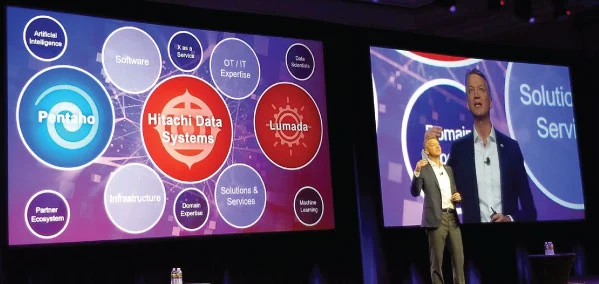
On the one hand, being comprised of existing Hitachi companies and products, Vantara is nothing new. On the other hand, it’s a new way for Hitachi to approach the IoT market. As Ravi Chalaka, Hitachi Vantara’s VP of Global IoT Marketing, told VDC at the conference, Vantara will do away with silos between these business units that formerly operated independently. That will enable the company to leverage its numerous products and services into customer-oriented end-to-end IoT solutions. “It’s the outcomes that matter,” Chalaka said, “not the specific technologies.” He also noted that Lumada was architected from the beginning to work in heterogeneous industrial environments, i.e. those composed of devices and systems from multiple manufacturers, not just from Hitachi.
In a market already crowded with hundreds of IoT platforms (including Lumada), a challenge for Hitachi Vantara will be to sufficiently differentiate its offerings to gain a critical mass of customers. Several Hitachi executives pointed out that no other company has a longer history than Hitachi in offering a combination of both Operational Technology (OT) and Information Technology (IT). And Hitachi has the ability to pre-provision Lumada agents in thousands of product lines it manufacturers, although the same can be said for many global industrial equipment manufacturers.
In VDC’s view, one key differentiator is that Hitachi has greater relevant experience in IT systems than, for example, GE or Honeywell, both of which historically offered general purpose computing systems but have since migrated to special purpose computing devices. Indeed at the Hitachi NEXT conference, many of the attendees that we met were users of Hitachi’s data storage systems in enterprise/IT applications. And Lumada would be a natural choice for those customers as their businesses expand into IoT data collection and analytics.
Another differentiator is that Hitachi is also offering a Lumada appliance, an easy-to-integrate rack-mounted instance of Lumada for on-premises deployment. It can be used standalone or with Lumada cloud integration. We believe the appliance will be an attractive choice for many industrial organizations that are not yet comfortable with moving their data to the cloud, but want a system which has that capability for the future.
And Pentaho’s analytics are already fully developed for specific industrial use cases. While not quite as broadly applicable as IBM’s Watson, Hitachi Vantara isn’t seeking to play Jeopardy. It’s mission is to reduce its customers’ jeopardy.
View the 2017 IoT & Embedded Technology Research Outline to learn more.